Saint John of Kanty

A professor who lived like the poor he taught about
John of Kanty was born in 1390 in the small Polish village of Kęty, which gave him the surname by which he's remembered — Kanty, or in some English sources, Cantius. He entered the University of Krakow as a young man, excelled there, and spent the rest of his life connected to it, first as a student, then as a parish priest for a short period, and finally, for decades, as a professor of theology and Sacred Scripture. By any measure of his era's academic world, he had a distinguished and stable career — a rare thing in the fifteenth century, when clerical appointments could shift unpredictably with politics and patronage.
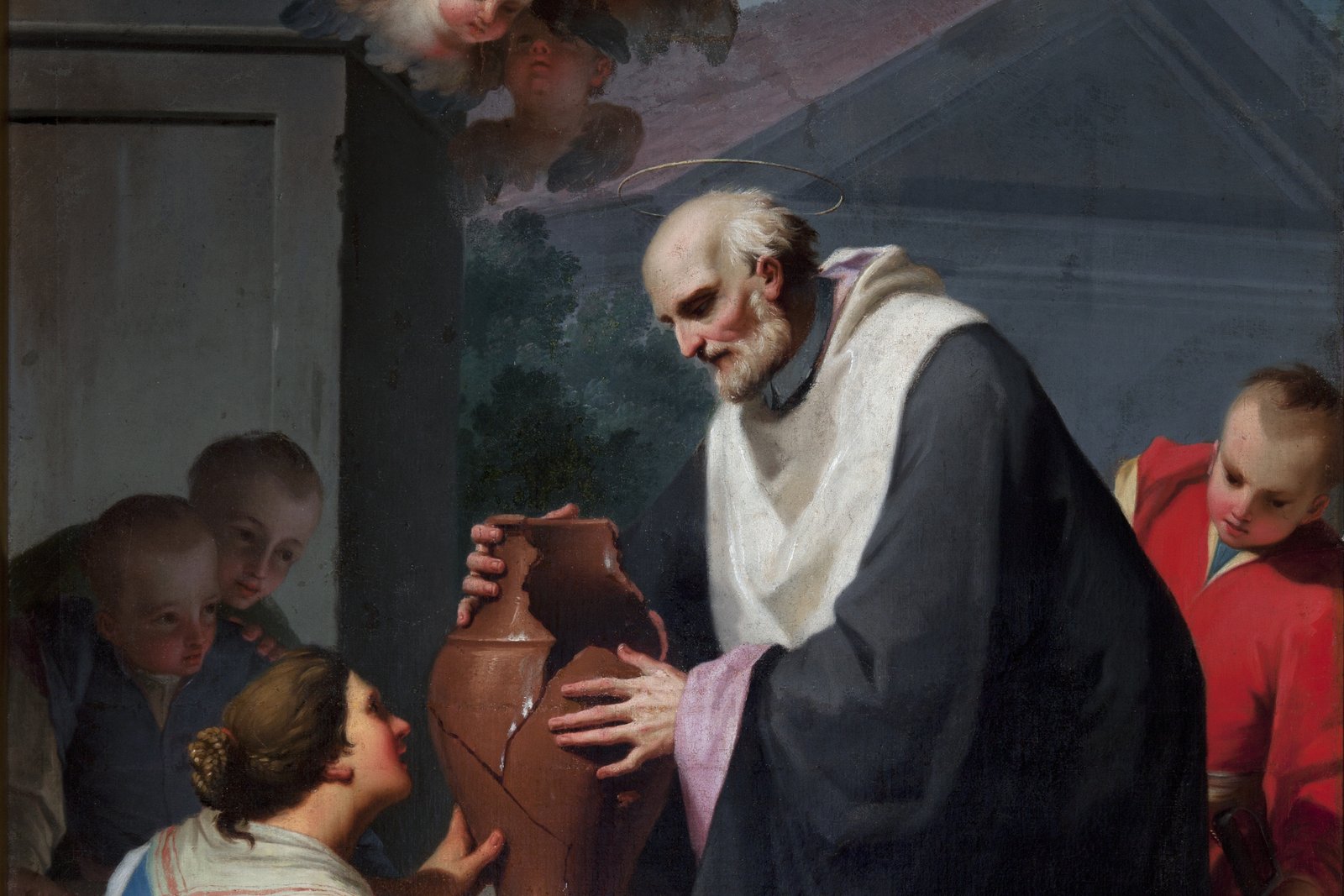
Tadeusz Kuntze, Miracle of St Jan Kanty, circa 1767 — National Museum in Krakow, public domain.
What set him apart from his academic peers wasn't the brilliance of his lectures, though contemporaries did praise his scholarship, but the severity of the poverty he chose to live in despite a comfortable university salary. He slept little, ate sparingly, wore threadbare clothing by choice, and gave away most of what he earned to students and townspeople who had less than he did. Multiple accounts from his own century describe him walking to the university lecture hall in worn-out shoes even when he could easily have afforded new ones, because he had already given the money meant for shoes to someone who needed it more.
The robbers on the road
The story most often told about John of Kanty concerns a pilgrimage he undertook, by tradition to Jerusalem, though some accounts place a similar episode on a journey to Rome. Traveling on foot along a lonely stretch of road, he was set upon by highway robbers, a real and common danger for medieval pilgrims traveling without armed escort. The robbers took his money, his belongings, and left him to continue on essentially empty-handed.
It was only after they had gone, tradition holds, that John remembered a handful of coins he had sewn into the lining of his cloak for emergencies — money the robbers had missed entirely. Rather than being relieved at having something left, he was troubled: he had made an interior resolution, before setting out, to give away everything asked of him on the journey, and he felt he had failed to keep that promise in full. He ran down the road after the men who had just robbed him and handed over the remaining coins. The robbers, so the story goes, were so struck by this that they returned everything they had taken. Whether or not every detail happened exactly as later hagiographers recorded it, the story circulated widely in Poland for centuries as a portrait of a man whose generosity operated by a logic entirely outside ordinary self-interest.
A rule for arguing gently
John of Kanty's academic career put him constantly in the middle of theological disputes — the ordinary friction of university life, then as now, where scholars disagree loudly and sometimes bitterly over fine points of doctrine. What made him unusual among his colleagues was a short personal rule he kept, reportedly written out and posted where he would see it, guiding how he was to conduct himself in any disagreement. Its substance, preserved across various tellings, urged him to bear insults patiently, to defend the truth firmly but without harshness toward the person holding the error, and to direct his most severe judgments inward, at his own faults, rather than outward at his opponents. A phrase often associated with this rule, sometimes rendered as "argue gently," has been repeated by later spiritual writers as a short and useful test for how any Christian, in the middle of a heated disagreement, might examine their own conduct rather than simply their argument.
This is worth distinguishing from a claim about doctrine itself: John of Kanty was no relativist, and he defended orthodox teaching firmly against error throughout his teaching career. The rule concerned manner, not content — how to hold a position without cruelty toward the person who disagrees, a distinction the Catechism echoes in its broader teaching on charity and truth working together (CCC 2469).
Feeding students from his own kitchen
Beyond the road-side generosity that made him famous, John of Kanty was known within Krakow itself for quieter, repeated acts of care toward poor students. He reportedly kept his own modest table open to those who had nothing, sometimes going without food himself so that a hungry student could eat, and he made multiple pilgrimages on foot to Rome over the course of his life, carrying his own belongings on his back rather than traveling with the comforts his university position could have afforded him. He died in Krakow on Christmas Eve, 1473, at the age of 83, having spent nearly his entire adult life within walking distance of the university that had shaped him.
Canonization and lasting patronage
Devotion to John of Kanty grew steadily in Poland in the centuries after his death, and he was canonized by Pope Clement XIII in 1767. He is honored today as a patron of Poland and Lithuania, and — fittingly, given his own life — as a patron of professors, students, and academics more broadly. His feast is celebrated on December 23rd, and university chapels across Poland, including one at his own alma mater in Krakow, still bear his name. For readers interested in other scholar-saints of the period whose intellectual work was matched by extraordinary personal holiness, see this blog's article on the Doctors of the Church, several of whom shared John of Kanty's combination of rigorous scholarship and radical simplicity of life.
Trivia
Who was Saint John of Kanty?
What is the famous story about John of Kanty and robbers?
What is John of Kanty's famous personal rule?
What is John of Kanty the patron saint of?
When is his feast day celebrated?
You May Also Like

Related Reading