Saint Joseph Calasanz, Priest

From canon law to the streets of Rome
Joseph Calasanz was born in 1557 in Peralta de la Sal, in the Aragon region of Spain, into a family of minor nobility that expected him to pursue a respectable ecclesiastical career suited to his social standing. He studied theology and canon law, was ordained a priest in 1583, and spent his early career in a series of increasingly responsible administrative posts within the Spanish Church, the kind of career trajectory that might reasonably have carried him toward a bishopric or a comfortable position within Church bureaucracy.
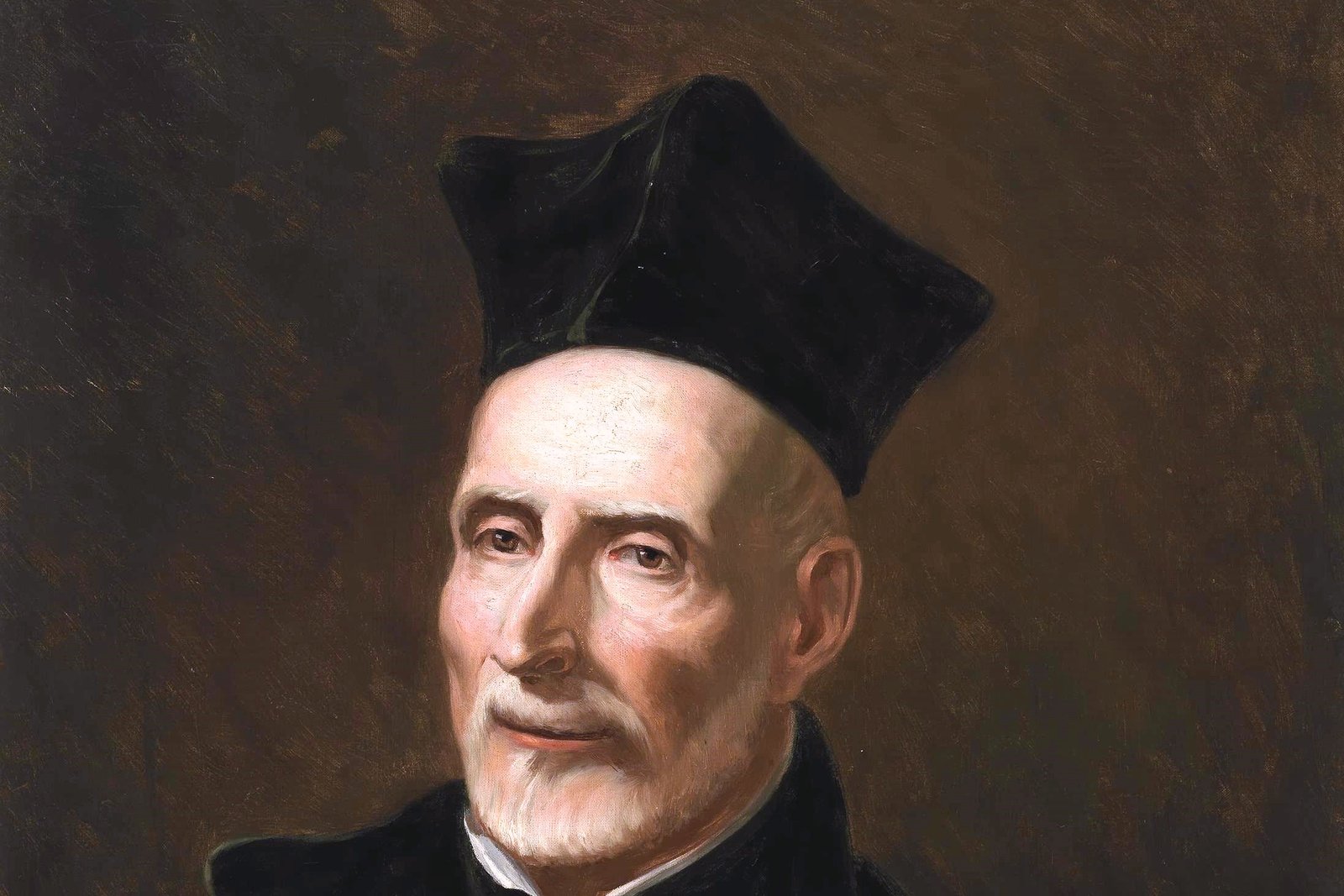
Francisco Jover y Casanova, portrait of Saint Joseph Calasanz, c. 1879 — public domain.
Instead, in 1592, at thirty-five, Calasanz moved to Rome, initially intending to pursue further ecclesiastical advancement through connections with a cardinal relative. What he found there, moving through the city's poorer neighborhoods as part of his charitable work with a Roman confraternity dedicated to helping the destitute, changed the direction of the rest of his life: enormous numbers of children living in poverty, with no access whatsoever to education, many of them effectively abandoned to the streets during the day while their parents worked or, in many cases, simply absent any functioning family structure at all.
The first free public school in Europe
In 1597, Calasanz rented a single room in the Trastevere district of Rome and began teaching a small group of poor children there himself, joined before long by a few other priests and laymen who shared his conviction that these children deserved an education as much as any wealthy family's sons. The school grew rapidly; within a few years, it had moved to larger premises and was educating hundreds of boys, offering instruction not only in reading, writing, and religious doctrine but also in mathematics and other practical subjects useful for future trade or craft work, a notably broader and more practically oriented curriculum than the classical, Latin-heavy education typically reserved for the children of the wealthy in that period.
Historians of education generally credit Calasanz's school as the first free, systematically organized public school in Europe open to children regardless of their family's ability to pay, a genuinely pioneering institutional model that predates the wider development of public education systems across Europe by well over a century. Pope Clement VIII, impressed by the school's rapid growth and evident success, granted it papal support, and the venture continued to expand steadily over the following years, eventually spreading to additional cities beyond Rome itself.
The Piarists
To sustain and formalize this growing educational mission, Calasanz founded a religious congregation specifically dedicated to it, the Congregation of the Religious Clerks Regular of the Pious Schools, whose members became known as the Piarists. Members of the order combined ordinary religious formation and vows with specific professional training as teachers, an arrangement that was, for its time, a notably specialized and modern conception of religious life organized around a single, clearly defined charitable and educational mission rather than the more general contemplative or pastoral focus of most existing religious orders.
The order grew substantially during Calasanz's lifetime, establishing schools in multiple Italian cities and eventually beyond Italy, and Calasanz himself, despite his advancing age, remained deeply involved in the practical, day-to-day administration of the schools, insisting on standards of teaching quality and, notably for the period, restraint in the use of corporal punishment that set his schools apart from much of the harsher pedagogical practice common elsewhere in seventeenth-century Europe.
Betrayal, suppression, and vindication
Calasanz's later years were marked by serious internal conflict within the very order he had founded. A member of the congregation, Mario Sozzi, working with allies inside the Roman Curia, mounted a sustained campaign of accusations against Calasanz's leadership, exploiting genuine financial difficulties and internal disagreements within the rapidly expanding order. The dispute grew serious enough that Pope Innocent X, in 1646, formally suppressed the Piarists as a religious congregation altogether, reducing its members to the status of secular priests living under a much looser, non-binding association rather than a formal religious order with vows.
Calasanz, by then in his late eighties, accepted the suppression with evident humility rather than open resistance, continuing to support and encourage his scattered former brethren as best he could until his death in 1648, without living to see the order's eventual restoration. Vindication came only after his death: the Piarists were fully restored as a religious congregation by Pope Alexander VII in 1656, and the order has continued its educational mission in various countries around the world into the present day.
A patron for every schoolchild
Joseph Calasanz was canonized in 1767, and in 1948 Pope Pius XII declared him the patron of all Christian popular schools, a formal recognition of the pioneering role his single rented room in Trastevere had played in the much larger history of accessible education across the Catholic world and beyond. His feast is celebrated on August 25, and Piarist schools continue to operate on several continents today, still guided by the same basic conviction that first sent a Spanish canon lawyer walking through the poorest streets of Rome: that a child's access to education should not depend on the wealth of the family into which they happened to be born.
Trivia
Who was Saint Joseph Calasanz?
What religious order did Joseph Calasanz found?
Why was Joseph Calasanz's order suppressed during his lifetime?
What made Joseph Calasanz's approach to education distinctive for his era?
When is the feast of Saint Joseph Calasanz, and what is he the patron of?
You May Also Like
Related Reading