Saint Maria Goretti, Virgin and Martyr

A farming family scraping by outside Rome
Maria Goretti was born on October 16, 1890, in Corinaldo, a small town in the Marche region of Italy, the third of seven children in a poor tenant-farming family. When her father died of malaria a few years later, the family — already struggling — moved south to work land near Nettuno, close to the coast south of Rome, sharing a farmhouse with another family, the Serenellis, in the kind of cramped rural arrangement common among Italian tenant farmers at the turn of the twentieth century. Maria's mother worked the fields alongside the men to keep the family afloat, which left Maria, still a child herself, responsible for cooking, mending, and caring for her younger siblings.
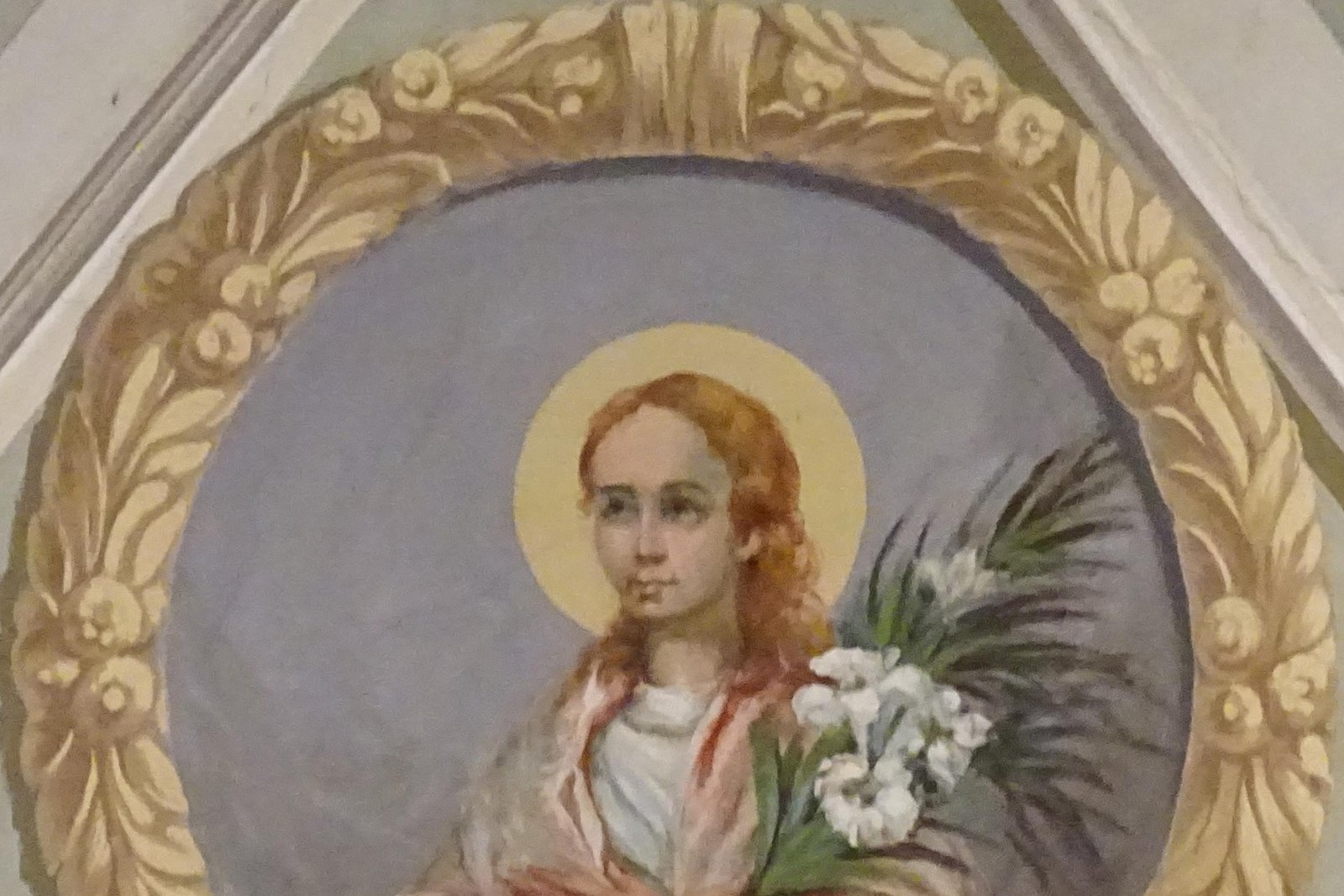
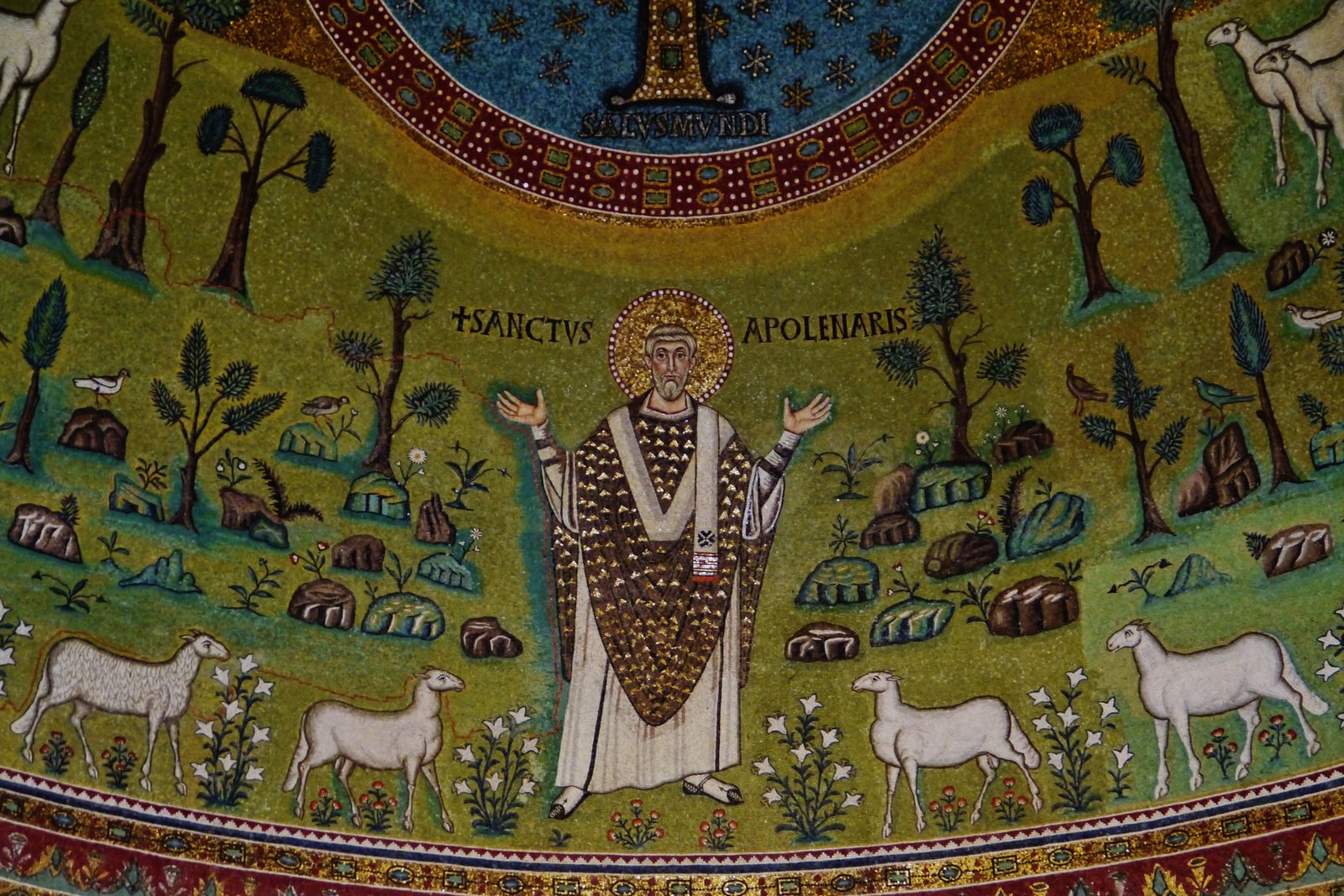
Fresco medallion, Chiesa di San Giuseppe, Pallanza, Italy — photo by Syrio, CC BY-SA 4.0
By all contemporary accounts she was an unremarkable, cheerful girl from an intensely poor household — she never attended school and was still preparing to make her First Communion at eleven, a detail that later struck people as almost unbearably poignant given what was coming. Nothing about her early life marked her out as anything other than one more child in one more struggling Italian farming family. That ordinariness is part of what makes her story land the way it does.
The afternoon of July 5, 1902
Alessandro Serenelli, the twenty-year-old son of the family sharing the farmhouse, had for some time been making unwanted advances toward Maria, threats she had reportedly resisted and kept largely to herself. On the afternoon of July 5, 1902, while most of the adults were out working the fields, Serenelli came into the farmhouse where Maria was sitting on the stairs mending a shirt while watching her infant sister. He forced her into a bedroom and demanded she submit to him. She refused, reportedly telling him it was a sin and that he would go to hell for it. When she continued to resist and threatened to cry out, he stabbed her repeatedly — accounts describe roughly fourteen wounds — before fleeing.
Maria was found still alive and rushed to a hospital in Nettuno, where surgeons operated without anesthesia, which was in short supply, while she remained conscious through much of it. She survived for about twenty hours after the attack. In that time, according to the testimony later given at her canonization process, a priest asked her whether she forgave her attacker, and she said that she did — adding that she wanted him with her in heaven. She died on July 6, 1902, having received Viaticum and, according to witnesses, expressing no bitterness toward the young man who had killed her.
Why the Church calls her a martyr
At first glance, Maria's death might read simply as a tragic act of violence rather than religious martyrdom in the traditional sense — she was not killed by a persecuting government or an enemy of the faith as such. But the Church's understanding of martyrdom, as the Catechism describes it, is "the supreme witness given to the truth of the faith" (CCC 2473), and the Church has long recognized a category of virgin martyrs — going back to early saints such as Saint Agnes of Rome, martyred at a similarly young age in the fourth century — who died specifically because they refused to consent to a grave sin against chastity when threatened with violence for that refusal. Maria's case was examined carefully under exactly this framework: she did not simply die violently, she was killed because she said no and would not be moved from that refusal even under threat of death. That distinction is what allowed the Church to recognize her death as martyrdom rather than ordinary homicide, and it is central to why her cause for canonization moved forward at all.
Serenelli's prison conversion
What happened afterward is, in its own way, as central to her story as the attack itself. Alessandro Serenelli was arrested, tried, and sentenced to thirty years in prison — he was spared execution partly because he was under the age of majority for full capital sentencing under the law of the time. For years he remained unrepentant. Then, according to his own later testimony, he experienced a vivid dream in which Maria appeared to him in a garden, gathering white flowers, which she offered to him one by one — a scene he came to interpret as a sign of her forgiveness reaching him directly. He converted, wrote a full confession, and upon his release after twenty-seven years, went, remarkably, to Maria's mother, Assunta, to beg her forgiveness in person. She forgave him, and the two attended Christmas Mass together the following day.
Serenelli spent the rest of his life as a laborer and later a lay brother associated with a Capuchin friary, living quietly and penitentially. In 1950, elderly and largely forgotten by the wider public, he was present in St. Peter's Square when Pope Pius XII canonized Maria Goretti — as was Assunta Goretti herself, the first mother in the modern era to witness the canonization of her own child. It is difficult to find a more complete arc of forgiveness anywhere in the record of the saints: victim, mother, and killer, reconciled across five decades.
A patron for the young and the wronged
Maria Goretti was canonized on June 24, 1950, and is remembered on her feast day, July 6 — the anniversary of her death. She is venerated today as a patron of youth, of victims of assault, and of the virtue of chastity understood broadly, not as a narrow rule but as the same courage to resist violation of one's dignity that she showed as a child with no education, no worldly standing, and nothing to rely on except her own conviction. Her story is often paired devotionally with other young martyrs and with figures associated with mercy and reconciliation, and her example continues to be cited in the Church's pastoral work with survivors of abuse and violence, precisely because her sanctity was never separated from the very real, very human suffering she endured. She remains one of the youngest canonized saints in the Church's history, and one whose story — brief as her life was — carries an unusually complete witness to both suffering and forgiveness held together.
Trivia
How old was Maria Goretti when she died?
Why is Maria Goretti considered a martyr rather than simply a murder victim?
Did Maria Goretti forgive the man who killed her?
What happened to Alessandro Serenelli after the murder?
When was Maria Goretti canonized, and what is her feast day?
You May Also Like
Related Reading