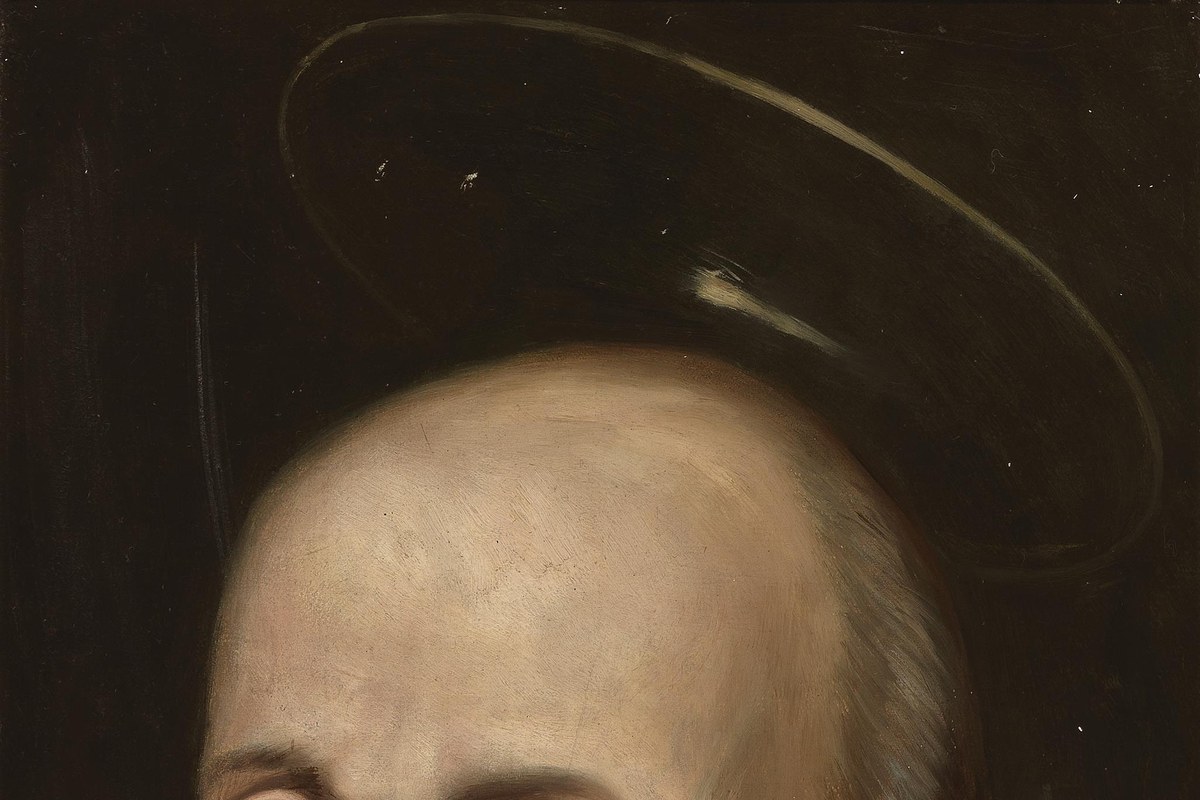
Saint Paulinus of Nola

A senator who chose a martyr's tomb over a Roman career
Paulinus was born around 354 into one of the wealthiest families in the Roman world, with estates in Gaul, Spain, and Italy that made him, by any measure, one of the richest men of his generation. He received the education expected of a young aristocrat destined for public life, studying rhetoric under the poet Ausonius, whose own letters to his former student survive and give us a glimpse of the young Paulinus as a gifted, promising writer. He held public office, served as a provincial governor in Campania, and by every visible marker was on track for a long and comfortable career inside the Roman administrative class.
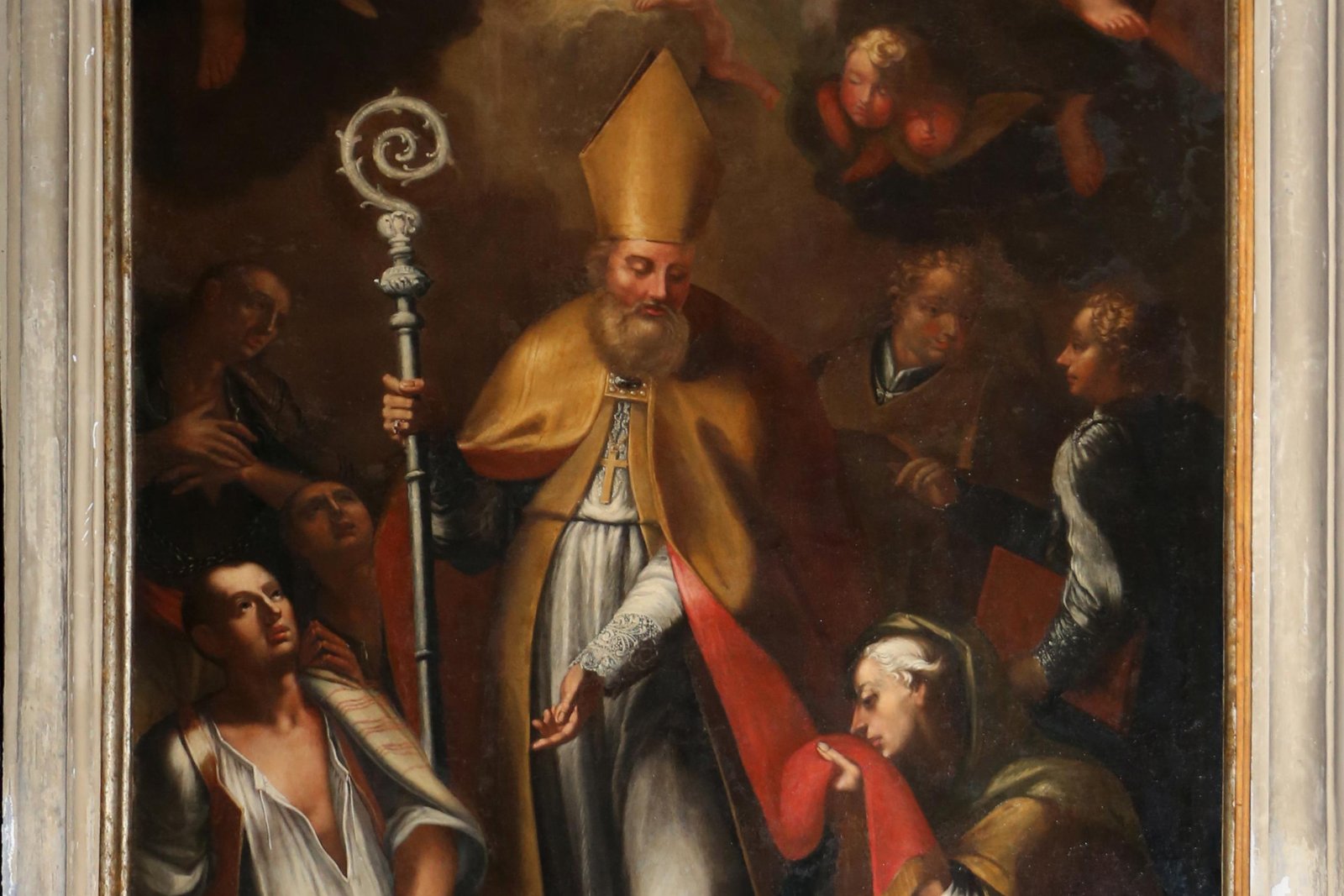
Giacomo Tais, Saint Paulinus, Bishop of Nola, 1729 — photo by Sailko, CC BY-SA 4.0
Somewhere in his thirties, that trajectory broke. Paulinus and his wife, Therasia, a Spanish noblewoman, were baptized, and the couple began a long, gradual turn away from the life their birth had prepared them for. The death of their only child shortly after his birth appears to have deepened this shift, and by the early 390s the couple had made a decision that stunned Paulinus's old friends and correspondents: they would sell off the family's vast holdings, distribute much of the proceeds to the poor, and live simply for the rest of their lives.
Settling at the shrine of an obscure martyr
Rather than retreat to a quiet corner of his own estates, Paulinus chose to settle at Nola, a town in Campania near a shrine dedicated to a local third-century martyr named Felix, a priest who had suffered persecution but survived to die peacefully years later. Felix was, in the wider scheme of the Roman Christian world, a minor figure, venerated locally but far from the prominence of martyrs honored in Rome itself. That was, in a sense, the point. Paulinus was drawn not to prestige but to a modest local cult he could serve directly, tending pilgrims, expanding the shrine's buildings, and composing poetry in Felix's honor that he read aloud each year on the martyr's feast day.
He and Therasia lived in a community there dedicated to prayer, hospitality for travelers and the poor, and manual work, a arrangement that anticipated in some ways the monastic communities that would soon spread across the Christian world. Paulinus was ordained a priest around 394, reportedly somewhat against his own preference for a quieter role, and was later made bishop of Nola, a position he held until his death around 431.
A friend to the great Christian minds of his age
What makes Paulinus unusually well documented for a figure of his time is his correspondence. He exchanged letters with an extraordinary circle of contemporaries, including Saint Augustine of Hippo, whose own writings mention Paulinus with clear affection and respect, and Saint Jerome, the formidable biblical scholar working on his Latin translation of Scripture in Bethlehem. These letters survive in significant number and give historians a rare window into the intellectual and spiritual concerns of educated Christians navigating the transition from a still partly pagan Roman aristocracy into a fully Christianized elite.
His poetry, too, has endured. Paulinus wrote a series of annual poems, known as the Natalicia, composed each year for the feast of Saint Felix, blending classical Latin verse forms with explicitly Christian devotion. Scholars of late antiquity often point to Paulinus as a pivotal figure in Christian Latin poetry, someone trained in the full classical tradition who redirected those literary skills entirely toward the praise of a local martyr's shrine rather than the imperial court that had once seemed his natural audience.
The legend of the bells
One of the most persistent stories attached to Paulinus's name is that he invented, or at least introduced, the use of bells in Christian worship, supposedly inspired by bluebell-shaped flowers near Nola or by small bells already used in the region. The Latin word for such a small bell, "nola," does share its root with the name of Paulinus's diocese, and later medieval writers ran with the connection, crediting the bishop directly with the innovation.
The trouble is that nothing in Paulinus's own extensive surviving writings mentions bells at all, and the claim appears to originate centuries after his death. Most modern historians treat the bell story as a charming but unverified legend, an example of how a genuine linguistic coincidence, the shared root between the town's name and a Latin word for bell, hardened over time into a firm attribution with no real documentary support. It is worth repeating as the popular tradition it is, while being honest that it does not rest on solid historical ground.
A model of voluntary simplicity
What survives most clearly from Paulinus's life, beyond any particular legend, is the example of a man who had every worldly advantage and set it aside deliberately, not out of failure or misfortune but as a considered response to his faith. His writings return again and again to a theme of detachment: wealth and status, he argued, were not evil in themselves, but they made poor foundations for a life aimed at something beyond this world.
The Church's decision to honor him with a feast on June 22 recognizes exactly that example, a wealthy, cultured, well-connected man who used his considerable talents in service of a small shrine and a community of the poor rather than in pursuit of further advancement. In an empire whose Christian aristocracy was still working out what it meant to hold both faith and privilege at once, Paulinus offered one clear, if demanding, answer.
Trivia
Who was Saint Paulinus of Nola?
When is the feast day of Saint Paulinus of Nola?
Is Saint Paulinus of Nola really connected to the invention of church bells?
What is Saint Paulinus of Nola best known for today?
You May Also Like
Related Reading