Saint Sylvester I, Pope

Pope in the year everything changed
Sylvester became Bishop of Rome on January 31, 314 AD — just months after the political ground had shifted beneath every Christian in the empire. In 313, Emperor Constantine and his co-emperor Licinius had issued the Edict of Milan, granting Christianity legal toleration across Roman territory for the first time since the faith's earliest years. For nearly three centuries before that edict, being a Christian in Rome had meant living with the real possibility of arrest, torture, or execution during periodic waves of imperial persecution, the last and most severe of which, under Diocletian, had ended only a decade earlier. Sylvester stepped into the papacy at the precise hinge point between that world and the one that came after it.
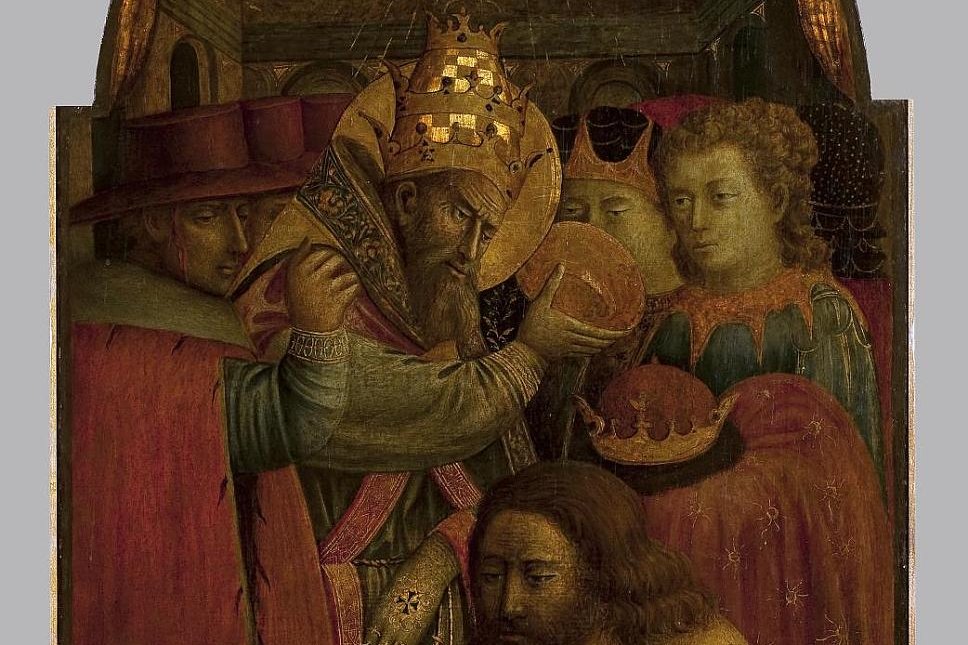
Andrea di Giusto, The Baptism of Constantine by Pope Sylvester I, 15th century — public domain.
Little is known with certainty about Sylvester's life before his election — later medieval legends filled in the gaps with elaborate, often unreliable stories, including an account of him curing Constantine of leprosy and baptizing the emperor personally, a tale modern historians regard as pious legend rather than history, since Constantine was in fact baptized on his deathbed in 337 by a different bishop entirely. What can be said with confidence is that Sylvester governed the Roman church for twenty-one years, from 314 to 335, through a period of extraordinarily rapid institutional change.
A church suddenly building basilicas
Under Constantine's patronage, Christianity moved in the space of a few years from underground worship in private homes and catacombs to a publicly favored religion with direct access to imperial resources. Several of Rome's most significant early basilicas trace their origins to this period, including the first church built on the site of what is now St. Peter's Basilica, and the Lateran Basilica, which Constantine gave to the Bishop of Rome as his cathedral church — a building that remains, to this day, the official cathedral of the pope as Bishop of Rome, even though St. Peter's is more widely recognized. Sylvester's pontificate oversaw this transformation from the ground up: church architecture, liturgical practice, and the visible public profile of Christianity in the imperial capital were all being reshaped at once, and largely on his watch.
Absent from Nicaea, but not uninvolved
The single most consequential event of Sylvester's era took place far from Rome, in the city of Nicaea in Asia Minor, where Constantine convened bishops from across the Christian world in 325 AD to resolve the Arian controversy — a dispute over whether Christ was truly divine and co-eternal with God the Father, or a created being subordinate to him, as the priest Arius had taught. The council that resulted produced the Nicene Creed, still recited today at Mass and in the liturgies of most major Christian traditions, affirming that the Son is "consubstantial with the Father" (CCC 250) against the Arian position.
Sylvester himself did not travel to Nicaea, likely owing to his advanced age and the demands of governing the Roman church directly, but he sent two priests, Vitus and Vincentius, to represent him and to signal papal assent to the council's conclusions — an early and significant example of the Bishop of Rome exercising authority over an ecumenical council through delegated representatives rather than personal attendance, a pattern that would recur in later church history.
A forged document that outlived its usefulness
Sylvester's name became attached, centuries after his death, to one of the most consequential forgeries in Church history: the so-called Donation of Constantine, a document purporting to record Constantine granting Sylvester and all future popes sweeping temporal authority over Rome, Italy, and the entire Western Roman Empire. For hundreds of years during the medieval period, this document was cited — genuinely believed to be authentic — as legal justification for papal claims to political power in the West. It was not until 1440 that the Italian Renaissance scholar and priest Lorenzo Valla demonstrated conclusively, through careful analysis of the document's Latin vocabulary and historical anachronisms, that it could not have been written in the fourth century and was almost certainly composed centuries later, likely in the 700s. Valla's work is now regarded as a foundational moment in the development of modern historical and textual criticism — ironically, one of Sylvester's more lasting legacies is a lesson in how not to build Church authority on unverified sources, a caution worth keeping in mind given this blog's own commitment to distinguishing verified history from later legend.
The pope whose feast became a party
Sylvester I died on December 31, 335 AD, and was buried in the Roman catacombs. His feast day, observed on the anniversary of his death, happens to fall on the very last day of the calendar year — a coincidence of the Julian and Gregorian calendar systems that has given his name an unusual second life. In Germany, Austria, Switzerland, Poland, and several other European countries, New Year's Eve itself is still commonly called "Silvester," and Silvester parties, fireworks, and celebrations are named for a fourth-century pope whose own life had nothing to do with year-end festivity — a quiet reminder of how deeply the rhythms of the Christian calendar have shaped even the most secular corners of European culture.
A legacy larger than the legends
Stripped of the later embellishments — the leprosy cure, the personal baptism of Constantine, the forged donation — Sylvester I's real historical role remains significant: he was the bishop who guided the Roman church through its most dramatic legal transformation, presided over the first great wave of Christian basilica-building in the empire's capital, and lent papal authority to the council that gave Christianity its most enduring statement of faith. He is remembered today less for any single dramatic act than for having steadily governed the Church through a hinge moment in its history — proof that not every consequential papacy needs a legend to be worth remembering.
Trivia
Who was Pope Sylvester I?
Did Sylvester I attend the Council of Nicaea?
What is the Donation of Constantine, and is it authentic?
Why is New Year's Eve called 'Silvester' in several European countries?
What happened to Christianity's legal status during Sylvester's papacy?
Related Reading