The Nicene Creed — Origins and Meaning of the Church's Central Profession of Faith

A council called to settle one question
The crisis behind the Nicene Creed had a single flashpoint: a priest in Alexandria named Arius was teaching that the Son of God was not eternal, but a created being — the greatest of creatures, but not truly God in the way the Father is God. Arius had a gift for making his position memorable, reportedly setting it to popular tunes so that dockworkers and sailors in Alexandria's harbor could be heard humming his theology, which only made the controversy harder for bishops to contain through ordinary preaching and correction. The dispute spread fast enough, and divided the Church sharply enough, that Emperor Constantine — recently converted, and eager for religious unity across his empire — summoned bishops from across the Christian world to the city of Nicaea in 325 to settle it.
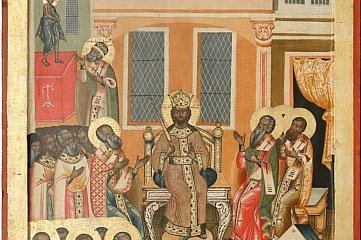
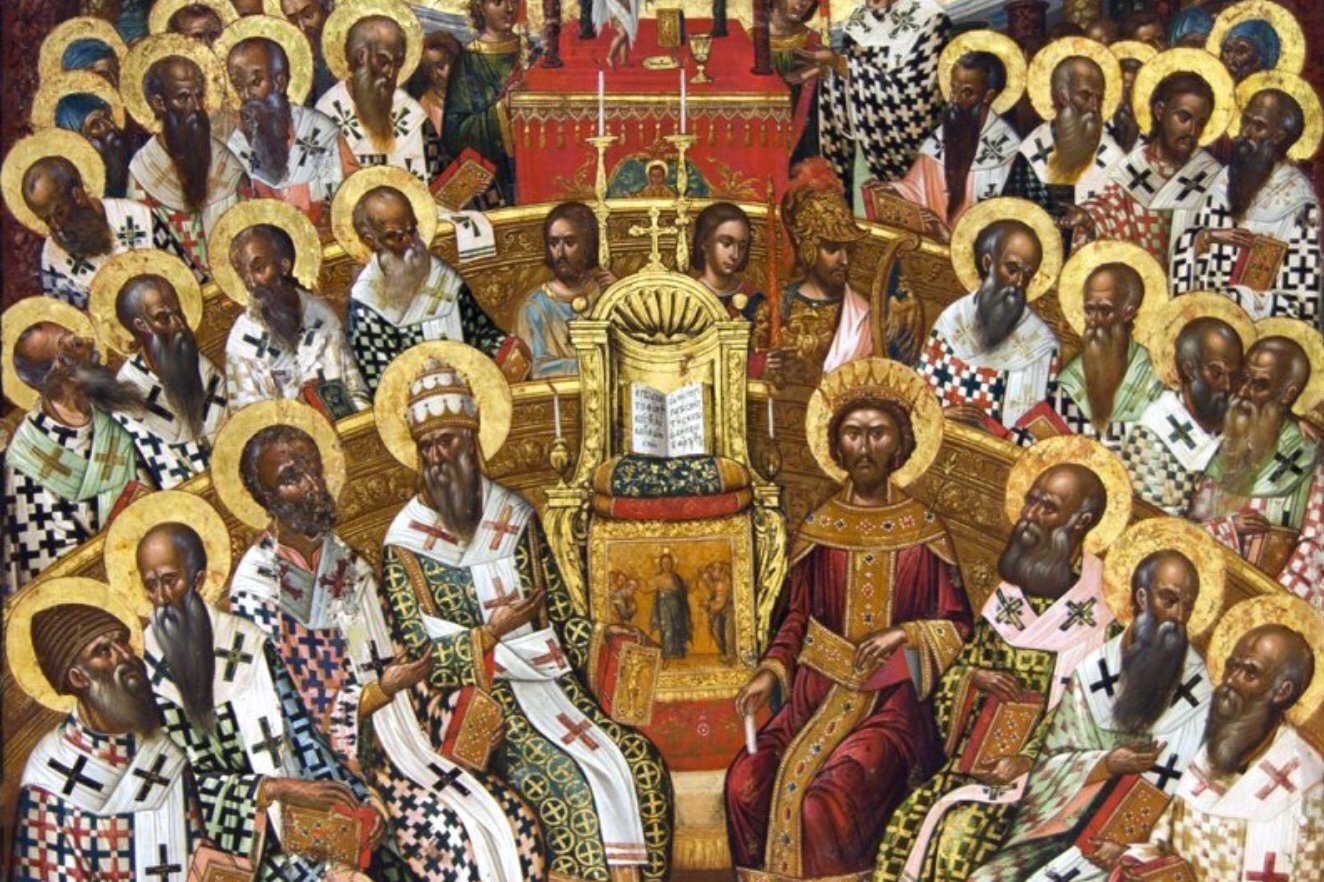
Anonymous, First Council of Nicaea (icon), 18th century (public domain)
More than two hundred bishops attended, several of them, according to later tradition, survivors of the persecutions under Diocletian just over a decade earlier — men who had been tortured or maimed for refusing to renounce Christianity now gathered, under an emperor's protection, to define it with precision. Among the attendees, later tradition holds, was a deacon from Alexandria named Athanasius, who had not yet become a bishop himself but who would spend the following decades of his life as the creed's fiercest defender, exiled from his own see multiple times by emperors sympathetic to Arian views. The council condemned Arius's teaching and produced a creed that pinned down, in precise language, what the Church actually believed about Christ's relationship to the Father — that the Son is "begotten, not made, consubstantial with the Father," sharing the Father's own divine nature rather than being a lesser, created being. The key Greek term, homoousios ("of one substance"), wasn't itself found anywhere in Scripture, which made it controversial even among bishops who opposed Arius — a reminder that the council wasn't simply reciting Bible verses, but exercising real theological judgment to rule out a reading of Scripture it judged mistaken.
Constantinople finishes the text
The 325 creed said comparatively little about the Holy Spirit, and by the later fourth century that gap had become its own theological flashpoint. The First Council of Constantinople in 381 expanded the creed, adding fuller language on the Holy Spirit ("the Lord, the giver of life, who proceeds from the Father") and on the Church itself ("one, holy, catholic, and apostolic"). The result — technically the Niceno-Constantinopolitan Creed, though almost universally shortened to "the Nicene Creed" — is the text still recited today.
What the creed actually says
The creed moves through the Trinity in order. It opens with the Father, "maker of heaven and earth, of all things visible and invisible." It spends its longest section on the Son — "God from God, Light from Light, true God from true God" — tracing his incarnation, suffering under Pontius Pilate, death, burial, resurrection "on the third day in accordance with the Scriptures," ascension, and promised return. It then turns to the Holy Spirit, "the Lord, the giver of life," and closes by professing belief in the Church, baptism "for the forgiveness of sins," the resurrection of the dead, and the life of the world to come.
The filioque, and a divide that never fully closed
One phrase in the Latin West's version of the creed has carried outsized historical weight: filioque, "and the Son," added to the line on the Holy Spirit's procession so that it reads the Spirit proceeds "from the Father and the Son." The Christian East never accepted the addition — objecting both to the theology and to the fact that it was inserted without the agreement of an ecumenical council — and the dispute remains, to this day, one of the significant points of separation between the Catholic and Eastern Orthodox Churches, a rare case of a single word shaping a thousand years of division.
An ecumenical text, even now
Few documents in Christian history carry the Nicene Creed's reach across otherwise divided churches. Catholic, Eastern Orthodox, and most mainline Protestant communities all recognize it as authoritative — a rare point of doctrinal agreement that predates the Reformation, the Great Schism between East and West, and nearly every later Christian division by centuries. That shared foundation is part of why ecumenical dialogue between Catholics and other Christian traditions so often returns to Nicaea as common ground, even where later disputes, like the filioque, pulled churches apart. It stands alongside the Apostles' Creed as one of the two professions of faith every Catholic learns, though the two serve different purposes — one built for the precision of doctrinal dispute, the other for the simplicity of a baptismal promise.
Still spoken every Sunday
Walk into a Catholic Mass on any given Sunday and, after the homily, the congregation stands and recites this same fourth-century text — sometimes the Nicene Creed in full, sometimes the shorter Apostles' Creed as an alternative. It's a striking bit of continuity: the specific wording fought over by bishops in a lakeside town seventeen centuries ago is still, almost verbatim, the language ordinary Catholics use every week to state what they believe. Few other moments in the Mass connect a modern congregation so directly to a specific, dateable event in the Church's ancient past — not a general inheritance of tradition, but the actual sentences argued over, word by word, in a room in Nicaea in the year 325.
Trivia
What is the Nicene Creed?
Where does the Nicene Creed come from?
What is the filioque controversy?
Is the Nicene Creed the same as the Apostles' Creed?
Why does the Nicene Creed say Christ is 'consubstantial' with the Father?
You May Also Like
Related Reading