Ruth and Naomi: A Loyalty That Outlasted Grief

Three widows on an empty road
The book of Ruth opens with famine, exile, and a chain of deaths that leaves three women alone. Naomi and her husband Elimelech had left Bethlehem for the plateau of Moab to escape a famine, and while there their two sons married Moabite women — Orpah and Ruth. Then, in the span of a few verses, Naomi's husband dies, and about a decade later, so do both of her sons (Ruth 1:1-5). What's left is a household of three widows with no men to provide for them, in a world where a woman's economic survival depended almost entirely on a husband, father, or son.
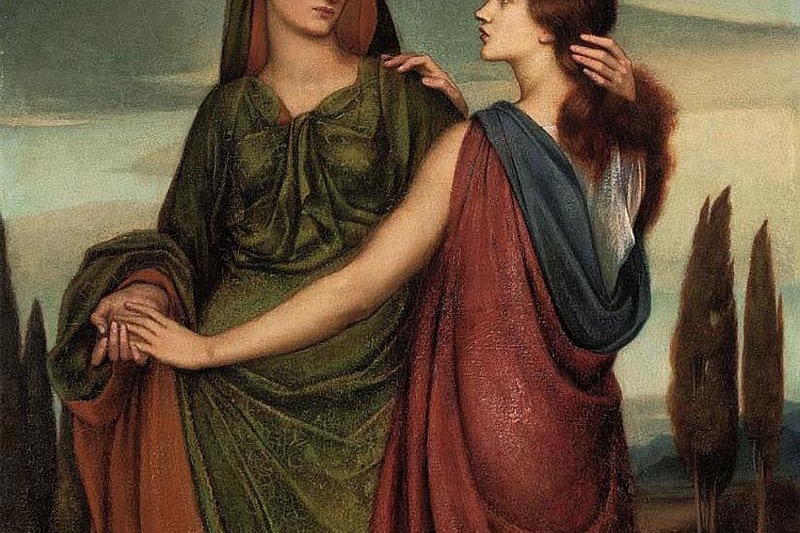
Evelyn De Morgan, Naomi and Ruth, 1887. Public domain, Wikimedia Commons.
When word reached Naomi that the famine back in Judah had ended, she decided to go home — and told her two daughters-in-law to go back to their own mothers' houses instead. It was, by any practical measure, sound advice. Naomi had no more sons to offer them, no realistic way to provide for two young Moabite widows in a foreign land, and every reason to think they'd have better prospects for remarriage among their own people. "May the Lord guide each of you to find a husband and a home in which you will be at rest," she told them, and kissed them goodbye (Ruth 1:8-9).
Orpah goes home. Ruth doesn't.
Orpah, after weeping, took the sensible path and returned to her people — a decision the text never criticizes. Ruth did not. Naomi pressed her a second time, even pointing out bluntly that she was too old to marry again and bear more sons for Ruth to wait for (Ruth 1:11-13). Ruth clung to her anyway, and what she said next is one of the most quoted passages in the Old Testament:
"Do not press me to go back and abandon you! Wherever you go I will go, wherever you lodge I will lodge. Your people shall be my people and your God, my God. Where you die I will die, and there be buried. May the Lord do thus to me, and more, if even death separates me from you!" (Ruth 1:16-17).
It's worth sitting with what that vow actually cost. Ruth wasn't just choosing loyalty to a person — she was renouncing her homeland, her family, and, most strikingly for the ancient world, the gods of her own people, in favor of the God of Israel. Naomi, seeing that Ruth's mind was made up, stopped arguing (Ruth 1:18).
Bitter homecoming
The two women arrived in Bethlehem together at the start of the barley harvest, and the town noticed. "Can this be Naomi?" the women asked. Naomi's answer is raw and unguarded: "Do not call me Naomi ['Sweet']. Call me Mara ['Bitter'], for the Almighty has made my life very bitter... I went away full, but the Lord has brought me back empty" (Ruth 1:20-21). It's a striking moment of honest grief rather than pious resignation — scripture doesn't sand down Naomi's anger at what she's lost, even as it credits her faith throughout the rest of the book.
From gleaning in the fields to King David's line
The chapters that follow Ruth 1 turn the story from lament toward restoration. Ruth goes out to gather leftover grain in the fields — a provision for the poor and foreigners built into Israelite law — and happens to glean in a field belonging to Boaz, a relative of Naomi's late husband. Boaz treats her with unusual kindness, and through Naomi's guidance and Boaz's honorable conduct, the two eventually marry. Their son, Obed, becomes the grandfather of King David — meaning a Moabite widow who chose loyalty over self-preservation ends up written directly into the ancestry of Israel's greatest king, and later, in Matthew's Gospel, into the genealogy of Jesus himself.
Boaz and the duty of the kinsman-redeemer
Boaz's kindness to Ruth wasn't simply personal generosity; it drew on a specific legal and social institution in ancient Israel called the go'el, or kinsman-redeemer — a near relative obligated, under certain circumstances, to marry a childless widow in the family, buy back family land that had been sold off in hardship, or otherwise step in to protect a vulnerable relative's future. Boaz was one such relative of Naomi's late husband, but not the closest one; the book of Ruth includes a small scene at the town gate where Boaz formally settles the matter with an unnamed closer relative before the marriage can proceed, following the customary legal procedure of the day (Ruth 4:1-12). It's an oddly procedural moment in an otherwise intimate story, and that's rather the point: Ruth's loyalty gets its happy ending not through a romantic shortcut but through a community's actual legal machinery for protecting widows, working exactly as it was supposed to.
A story the Church still tells about fidelity
Catholic tradition holds up Ruth's vow less as a rule about family obligation and more as a portrait of hesed — a Hebrew word often translated as steadfast loving-kindness, the same quality scripture repeatedly attributes to God's own faithfulness toward Israel. Ruth's declaration to Naomi mirrors, in miniature, the kind of covenant loyalty God shows his people: not loyalty because it's owed, but loyalty chosen freely, at cost, when walking away would have been easier and arguably wiser. That's part of why the book of Ruth has endured well beyond its four short chapters — it's a story about a foreigner and a widow, two of the most vulnerable figures in the ancient world, choosing each other, and being woven by it into salvation history itself.
The book also sits deliberately alongside other Old Testament stories of women whose courage or loyalty changes the course of Israel's history, a company that includes figures like Esther, who risks her own life to save her people generations later. Both women act from positions of real vulnerability — a foreign widow with no legal standing, a queen whose own life is forfeit if she speaks wrongly — and both end up central to the story of how God works through ordinary, costly human choices rather than around them. Ruth's inclusion by name in Matthew's genealogy of Jesus, alongside three other women with complicated or foreign backgrounds, reinforces the same point: the ancestry of the Messiah runs directly through people the world had little reason to expect greatness from.
Trivia
What is Ruth's famous vow to Naomi?
Why did Naomi try to send Ruth and Orpah away?
Who was Orpah, and why is she less remembered than Ruth?
Is Ruth an ancestor of King David?
Why did Naomi change her name to Mara?
Related Reading