Tobit and the Angel Raphael

A Man Undone by Righteousness
Tobit's troubles began, ironically, from his own faithfulness. Living in exile in Nineveh, he made a habit of secretly burying fellow Israelites executed by the king — an act of mercy that was also a capital offense under the current regime. He lost his property fleeing that danger, and later, resting in his courtyard, sparrow droppings fell into his eyes while he slept, leaving him permanently blind (Tobit 2:10). Poor, blind, and dependent on his wife's meager earnings, Tobit reached a point of such despair that he prayed for God simply to let him die, "for it is better for me to die than to live" (3:6).
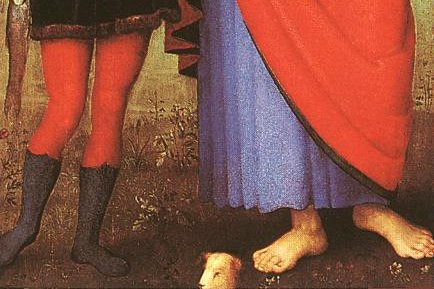
Pietro Perugino, Tobias with the Angel Raphael, c. 1500-1505 — public domain.
At the same time, in a different city, a young woman named Sarah was suffering her own devastation — a demon named Asmodeus had killed each of her seven husbands on their wedding night before the marriage could be consummated, and she too had prayed for death. Scripture makes clear both prayers reach heaven at the same moment, and God dispatches the same answer to both households: the archangel Raphael.
A Stranger Hired for a Journey
Tobit, remembering money he had once left with a kinsman named Gabael in Media, sent his son Tobiah to retrieve it — a journey requiring a knowledgeable, trustworthy guide. Tobiah went to the marketplace and "found the angel Raphael standing before him (though he did not know that this was an angel of God)" (5:4). When Tobiah asked where he was from, Raphael answered simply, "I am an Israelite, one of your kindred. I have come here to work" (5:5), and confirmed he knew the roads to Media well, having traveled them often. Tobiah hired him on the spot, with his father's blessing, never suspecting anything beyond a capable travel companion.
What Raphael Accomplished Along the Way
The journey becomes the engine of the entire book's resolution. At a river crossing, Raphael instructs Tobiah to catch a large fish and keep its heart, liver, and gall — organs that will prove essential later. Arriving in Media, Raphael arranges Tobiah's marriage to Sarah, instructing him to burn the fish's heart and liver on their wedding night, whose smoke drives the demon Asmodeus away permanently. Raphael also personally travels ahead to secure the money from Gabael, completing the original purpose of the trip.
The Healing of Tobit's Eyes
Returning home with his new bride and the retrieved money, Tobiah follows Raphael's final instruction and anoints his father's blind eyes with the fish's gall. The effect is immediate: "the white film scaled off from the corners of his eyes... he could see his son and threw his arms around him" (11:13). The man who had prayed for death now finds his sight, his son's marriage, and his family's fortune all restored within the span of one journey he never personally undertook.
The Angel Reveals Himself
When Tobit and Tobiah try to pay their guide half of everything they had brought back, Raphael refuses and instead reveals what he truly is: "I was sent to put you to the test. At the same time, however, God sent me to heal you and your daughter-in-law Sarah... I am Raphael, one of the seven angels who stand and serve before the Glory of the Lord" (12:14-15). He instructs them to praise God rather than him, and then vanishes from their sight.
A Small, Easily Missed Detail: The Dog
Among the book's many small realistic touches, one has long caught the attention of readers and artists alike: Tobiah does not travel with Raphael alone. Scripture notes almost in passing that "the dog followed Tobiah out and went along with them" as they set out from Tobit's house (Tobit 6:2), and the animal reappears at the very end of the journey, running ahead to announce their return before Tobiah himself arrives. It is one of very few named or noted animal companions across the whole of Scripture given this kind of continuous, almost domestic presence, and later Christian art frequently includes the dog trotting alongside Tobiah and Raphael in depictions of the journey, a small human, homely detail inside a story that is otherwise about angels, demons, and healing.
Almsgiving as the Book's Deeper Theme
Beneath the adventure-narrative surface, the Book of Tobit is structured as an extended teaching on almsgiving and mercy. Before Tobit's blindness, the book opens by establishing his lifelong habit of giving generously to the poor and burying the dead at personal risk; near the story's close, Tobit's own deathbed instruction to his son returns explicitly to that same theme: "Give alms from your possessions. Do not turn your face away from any of the poor, so that God’s face will not be turned away from you." (Tobit 4:7). Raphael himself, once he reveals his identity, tells Tobit and Tobiah plainly that "good deeds done with charity" were the very acts that carried their prayers to God in the first place, making the whole rescue narrative less a story about a lucky encounter with an angel and more a demonstration of what the book itself understands as the connection between mercy shown to others and mercy eventually received.
Catholic Reading: Providence Working Through Ordinary Means
Tobit belongs to the Catholic canon's deuterocanonical books, and its story is treated as a rich meditation on divine providence working quietly through completely ordinary circumstances — a hired travel guide, a fish caught at a riverbank, a young man simply doing what his father asked. Nothing in the journey looks miraculous while it is happening; only in hindsight, once Raphael's identity is revealed, does the entire trip resolve into a single coordinated act of mercy answering two desperate prayers offered independently and, as far as either person knew, unheard.
Raphael's name, meaning "God heals," and his traditional place among the archangels recognized in Catholic tradition (alongside Michael and Gabriel) have made Tobit a touchstone for reflection on angelic guidance — not angels as dramatic, visibly supernatural interveners, but as companions walking beside ordinary human effort, often unrecognized until the work is already done.
Related reading: see Judith and Holofernes for another deuterocanonical book centered on courage and divine deliverance, and Elijah and the Widow of Zarephath for another story of provision arriving through an unexpected guest.
Trivia
Why was Tobit blind and in despair?
Who did Tobit's son Tobiah hire as a traveling companion?
What did Raphael help Tobiah accomplish on the journey?
How was Tobit's blindness healed?
When did Raphael reveal who he really was?
Related Reading