Why Believe in God? Five Arguments and Two Converts Who Lived Them

A question that predates every argument for it
People rarely arrive at "why believe in God" the way a philosophy student approaches a logic problem — cool, detached, working through premises. Usually the question shows up already loaded: a funeral, a diagnosis, a late-night conversation with a friend certain there's nothing beyond what we can measure. The arguments below are real, and Catholic teaching takes them seriously enough to say God's existence "can be known with certainty from the created world by the natural light of human reason" (CCC 36, citing the First Vatican Council's Dei Filius). But arguments alone rarely convert anyone. It's worth looking at what happened when two of the sharpest minds in Christian history — one in the fourth century, one in the twentieth — worked through the question themselves.
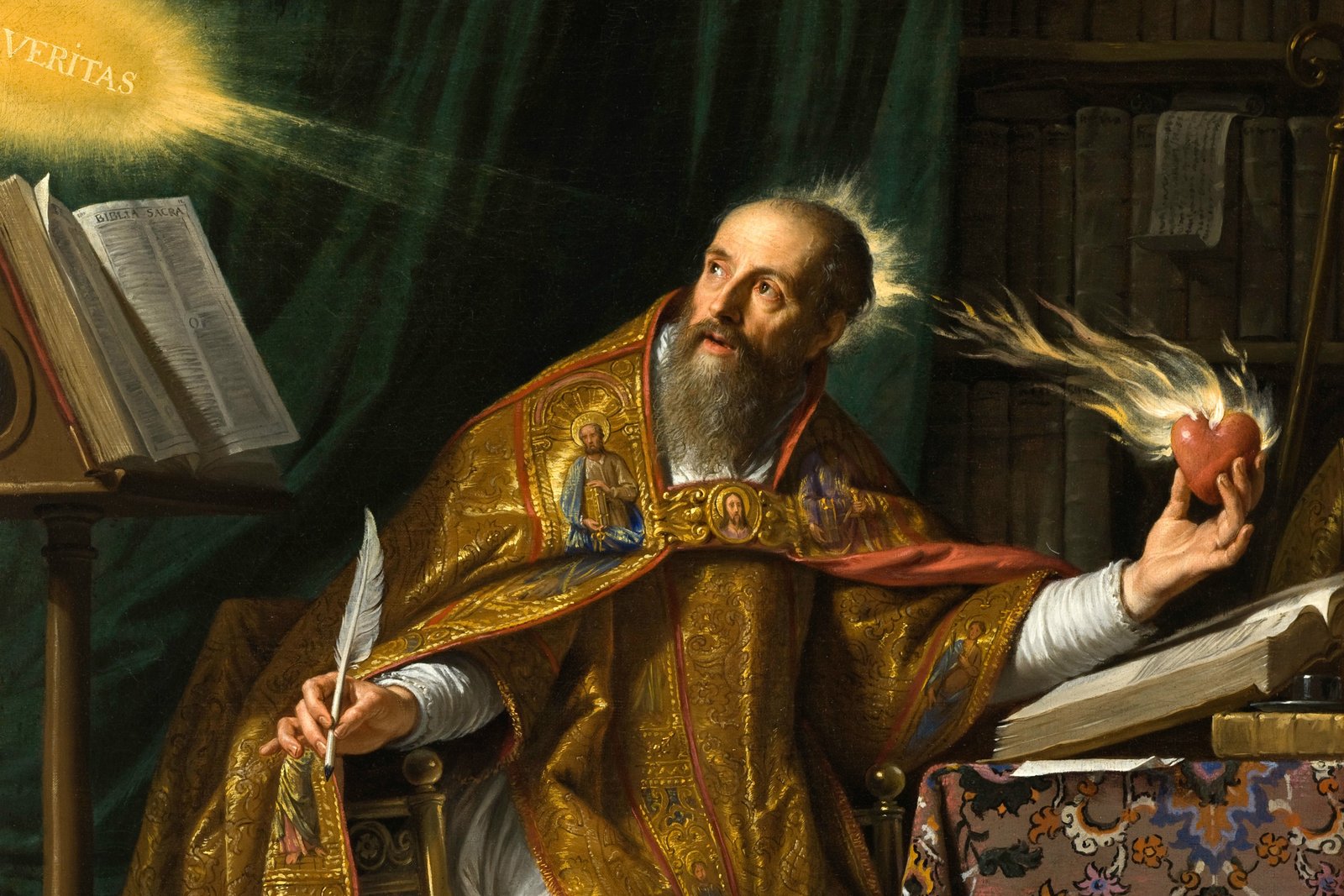
Philippe de Champaigne, Saint Augustine, c. 1645-1650, public domain (Wikimedia Commons).
Augustine: talked himself into circles until he couldn't anymore
Saint Augustine of Hippo was not a simple man arriving at a simple faith. He was a professional rhetorician, trained to argue any side of any question, and for over a decade he tried on worldview after worldview — years with the Manichaeans, a sect that offered him a tidy explanation for evil built on two competing cosmic forces, then a stretch of skeptical philosophy that questioned whether certainty was possible about anything at all. None of it held. He describes the whole search, with brutal honesty, in the Confessions — a man clever enough to defend almost any position, and miserable precisely because none of the positions he could defend actually matched what he found when he looked honestly at the world and at himself.
The turn didn't come from a knockdown argument. It came in a garden in Milan, where Augustine, weeping over a life he couldn't seem to fix, heard what sounded like a child's voice chanting "take up and read." He opened a book of Paul's letters lying nearby to a passage that struck him as written specifically for him, and the wandering stopped. What matters for the question of belief itself is what came before that moment: years of Augustine's considerable intellect testing every alternative on offer and finding each one, on its own terms, unable to answer what he later put in one line — "You have made us for yourself, O Lord, and our heart is restless until it rests in you." That's not a mood. It's closer to what philosophers call the argument from desire: a longing that nothing finite fully satisfies, treated by Augustine not as proof of fantasy but as evidence pointing toward something real that the longing was built to find.
Edith Stein: a philosopher who didn't stop being one
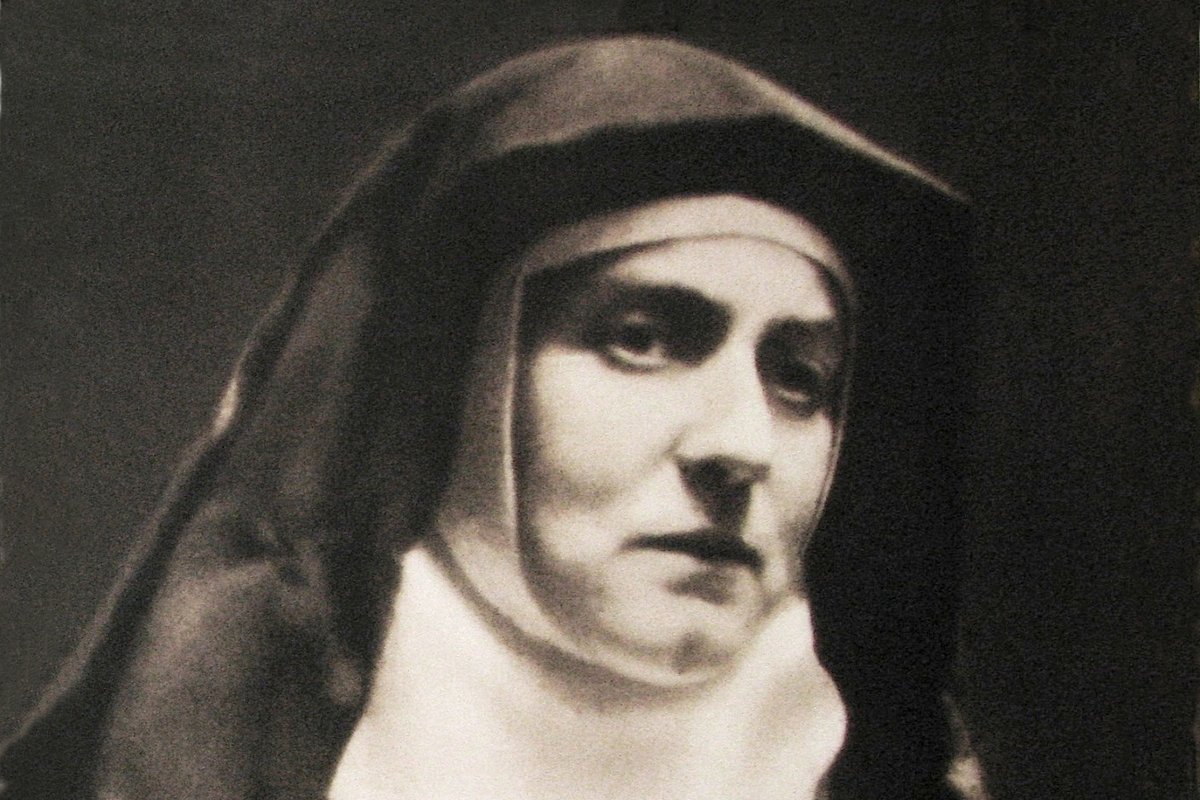
Saint Edith Stein makes an even harder case to dismiss as wishful thinking, because she was, by any measure, one of the more rigorous minds of her generation. A student of Edmund Husserl, the founder of phenomenology, she earned her doctorate in philosophy in 1916 — one of the first women in Germany to do so — and had, by her own account, drifted from her family's Judaism into settled agnosticism. She wasn't looking for God when, visiting friends in 1921, she picked up the autobiography of Teresa of Ávila, a sixteenth-century Spanish Carmelite mystic. She read it straight through, overnight, without stopping, and set it down having reportedly said only, "This is the truth."
What's notable is what she did next: she didn't abandon philosophy for piety. She spent the following years still teaching and lecturing before entering the Carmelite convent in 1934. Her conversion looks less like an emotional escape from rigorous thought and more like rigorous thought arriving somewhere it hadn't expected to land — and staying there, under scrutiny, for the rest of her life. That itself is a kind of evidence worth weighing: not proof in the geometric sense, but the testimony of someone with every intellectual tool available to interrogate a claim before accepting it, doing exactly that, and accepting it anyway.
Five arguments, briefly
The Catholic tradition doesn't rest its case for God's existence on conversion stories alone, however moving they are. Several classical arguments recur across centuries of theology and philosophy:
- Contingency. Nothing in the universe explains its own existence — every object, event, and person depends on something prior. Reasoning back along that chain, philosophers from Aristotle to Aquinas argue that a chain of purely dependent things can't explain itself; something must exist in its own right. The Catechism frames it simply: the world and human beings "attest that they contain within themselves neither their first principle nor their final end" (CCC 34).
- Design and order. The universe operates by intelligible, mathematically describable laws rather than chaos — a fact scientists rely on daily without being able to fully explain why reality should be ordered and comprehensible at all.
- The moral argument. Human beings across radically different cultures recognize something like a real moral law — a shared sense that certain things (needless cruelty, betrayal of the innocent) are actually wrong, not just locally disapproved of. Where does a law with that kind of authority come from, if not from something beyond human preference?
- The argument from desire, which Augustine's own life illustrates directly: human beings experience longings — for meaning, for permanence, for a love that doesn't end — that nothing finite fully satisfies, even when every finite good on offer is obtained.
- Religious experience, cautiously handled: the widespread, cross-cultural experience of encountering something beyond the self, which proves little alone, but grows harder to wave away as pure delusion when it recurs across centuries in minds, like Augustine's and Stein's, not otherwise prone to credulity.
Reason gets you to the door
It's worth being honest about the limits here, because the Church itself is honest about them. Vatican I's teaching that God's existence is knowable "with certainty" by reason is a real, defined doctrine, not a throwaway line (CCC 36). But the Catechism adds, almost immediately, that this knowledge "is not immediate" — people can miss it, resist it, or have it "obscured" by bad ideas about God, poor example from believers, or simple reluctance to take the question seriously (CCC 37). Years of arguing with the Manichaeans didn't convert Augustine. Edith Stein's philosophical training didn't produce her conversion by itself, either — it took a single unplanned night with a book that wasn't philosophy at all. Reason gets a person reliably to the conclusion that a first cause, a moral lawgiver, is more reasonable to affirm than to deny. What carries a person from that conclusion into an actual relationship with God is what the Church calls faith — not opposed to reason, but not reducible to it either.
What their stories actually prove
Neither Augustine nor Stein offers a knockdown argument that settles the question for everyone reading this. What they offer is harder to dismiss: direct testimony, from two people with every capability to resist an unconvincing claim, that the search for God is not a search reason has to abandon in order to complete. Augustine kept arguing his whole life, against Manichaeans, Donatists, and Pelagians, decades after his conversion. Stein kept teaching philosophy after hers. Belief, for both of them, didn't replace their minds. It gave their minds somewhere to finally rest.
Trivia
What are the main arguments Catholics give for God's existence?
Does the Catholic Church teach that God's existence can be proven with certainty by reason alone?
Was Saint Augustine an atheist before his conversion?
What convinced Edith Stein, a philosopher, to become Catholic?
If these arguments are convincing, why do intelligent people still not believe in God?
You May Also Like
Related Reading