Saint André Bessette

A childhood that gave him little advantage
Alfred Bessette — the name he was born with, before taking "André" in religious life — grew up in rural Quebec, orphaned as a child and raised for a time by relatives after both his parents died young. He worked a string of demanding manual jobs across Canada and the United States as a young man, none of it steady, and his health throughout this period was consistently poor. By the time he sought admission to the Congregation of Holy Cross in his twenties, he arrived with little formal education and a body that had already been worn down by years of hard, unstable labor.
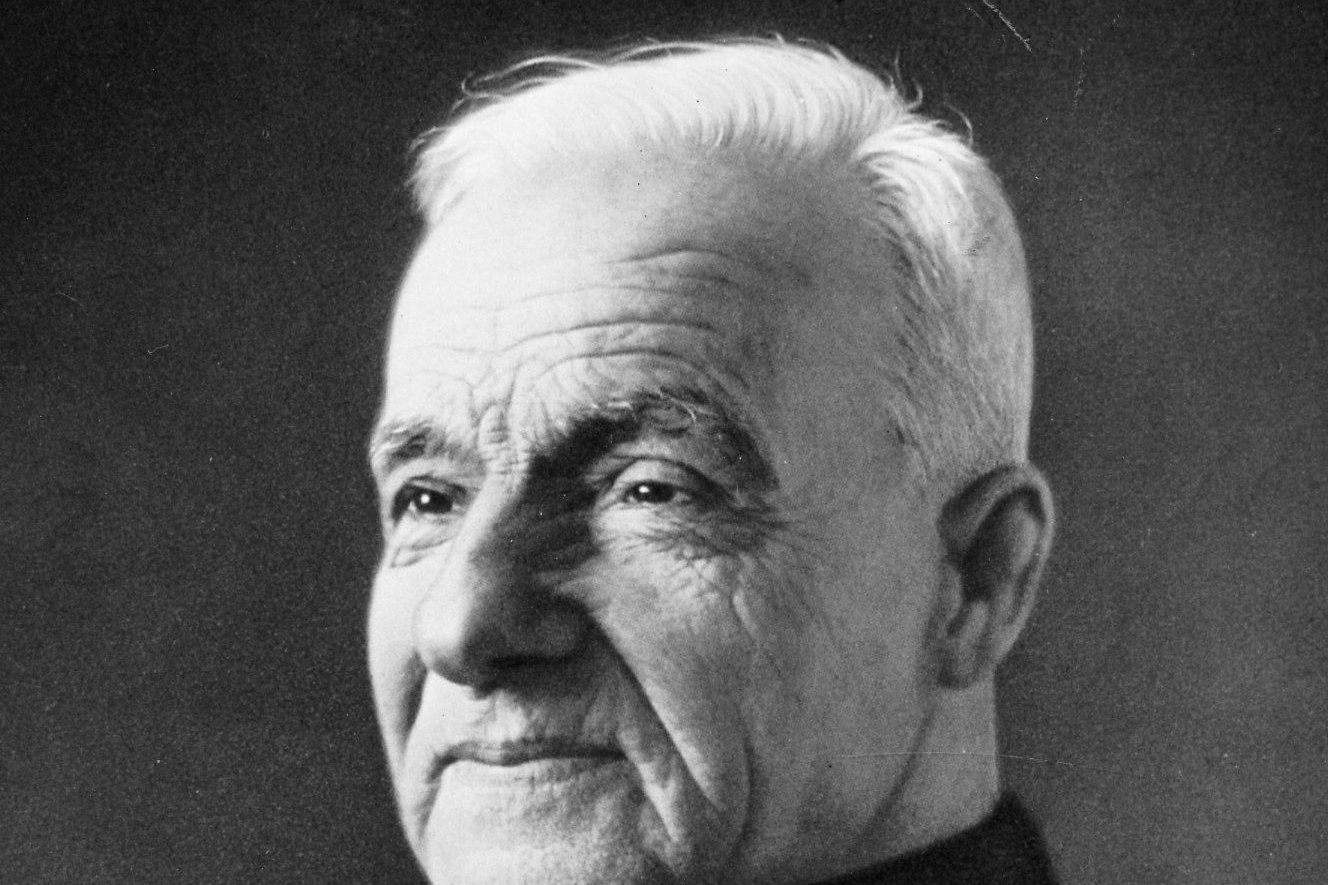
Photographer unknown, before 1938 — public domain.
Nearly turned away for being too frail
The congregation's superiors reportedly hesitated over admitting him specifically because of his fragile health, uncertain he could sustain the demands of religious life. According to the tradition surrounding his early years with Holy Cross, it took the direct intervention of a local bishop to secure his admission. Once accepted, André was assigned to the lowest, least prestigious job available — doorkeeper at Notre Dame College in Montreal — a role he ended up holding for roughly forty years.
A door that a million people eventually walked through
What began as a simple porter's post gradually became something else entirely. As word spread of healings people attributed to his prayers, visitors began arriving at the college specifically to see him, first in small numbers and eventually in a steady stream that reportedly reached well over a million visitors across his lifetime. André met every one of them with the same consistent message: he wasn't the source of any healing. He redirected credit to Saint Joseph, the patron of the college and, by his own account, the true intercessor behind any recovery attributed to him.
André's method, as described by those who visited him, was strikingly simple and repetitive: he would listen to a visitor's request, often press a medal of Saint Joseph or a small amount of oil from a lamp burning before an image of the saint to the person's afflicted body, and pray briefly, insisting the whole time that whatever happened next was between the visitor and Saint Joseph, not a result of anything special in him. Doctors and Church authorities of the period were, understandably, cautious about the volume of healing claims associated with him, and the Congregation of Holy Cross itself was sometimes uneasy about the scale of attention a simple doorkeeper was drawing — but the crowds kept coming regardless, and André kept greeting them at the same door, year after year, without ever changing his account of where any credit belonged.
Building a shrine out of small donations
Convinced of Saint Joseph's particular power of intercession, André began raising money — often in very small individual donations — to build a shrine in his honor on Mount Royal, across from the college where he worked. What started modestly grew, over decades, into Saint Joseph's Oratory, today one of the largest and most-visited Catholic shrines in the world, drawing millions of pilgrims annually. André lived to see much of the Oratory's major construction underway, though its largest dome wasn't completed until after his death.
From a small wayside chapel to a mountaintop basilica
The Oratory's beginnings were almost comically modest compared to what it eventually became. André's first chapel on Mount Royal, built in 1904, was a small wooden structure barely large enough to hold a handful of worshipers, funded by coins André collected during his rounds and from the nickel-and-dime haircuts he gave fellow brothers at the college, since he had also learned barbering as a young man. Construction on the far larger basilica that stands there today began in the 1920s and continued in stages for decades, funded overwhelmingly by ordinary pilgrims' small gifts rather than any single wealthy benefactor — a fundraising model that mirrored, on a vastly larger scale, exactly how André had always operated: one modest, freely given donation at a time. Today Saint Joseph's Oratory's dome is among the largest of any church in the world, and the site draws roughly two million visitors annually, an extraordinary outcome for a shrine that began as a doorkeeper's side project.
Canonization
André Bessette died in Montreal in January 1937, and reports at the time described crowds numbering in the hundreds of thousands filing past his body to pay respects, despite bitter winter weather — a scale that reflected just how deeply his decades at the college door had touched the wider community. His cause for canonization opened relatively quickly given the scale of popular devotion already surrounding him, and he was beatified by Pope John Paul II in 1982. Pope Benedict XVI canonized him in 2010, after the Vatican recognized a second miracle attributed to his intercession — the healing of a child struck by a car — following the standard process required for sainthood beyond beatification. His feast day is celebrated on January 6, and he's buried at Saint Joseph's Oratory, the shrine that grew, quite literally, out of the small donations he collected one visitor at a time.
Trivia
Why did the Congregation of Holy Cross nearly refuse to admit André Bessette?
What job was André given within the Congregation of Holy Cross, and for how long did he do it?
What did André build, and how did he fund it?
Did André Bessette claim to perform the healings people credited him with?
When was André Bessette canonized?
You May Also Like
Related Reading