Saint Joachim, Traditional Father of the Virgin Mary

A father the Gospels never name
Just as with Anne, the woman honored as Mary's mother, the New Testament says nothing at all about Mary's father. No Gospel names him, describes him, or even implies details about the household Mary grew up in before the angel Gabriel's visit. That silence is exactly the space the Protoevangelium of James fills. Written in the mid-to-late 2nd century — well over a hundred years after the events it claims to describe — this apocryphal text (meaning a writing outside the New Testament canon the Church recognizes as inspired Scripture) names Mary's father as Joachim, a wealthy and devout man distressed above all by one thing: he and his wife Anne had no children.
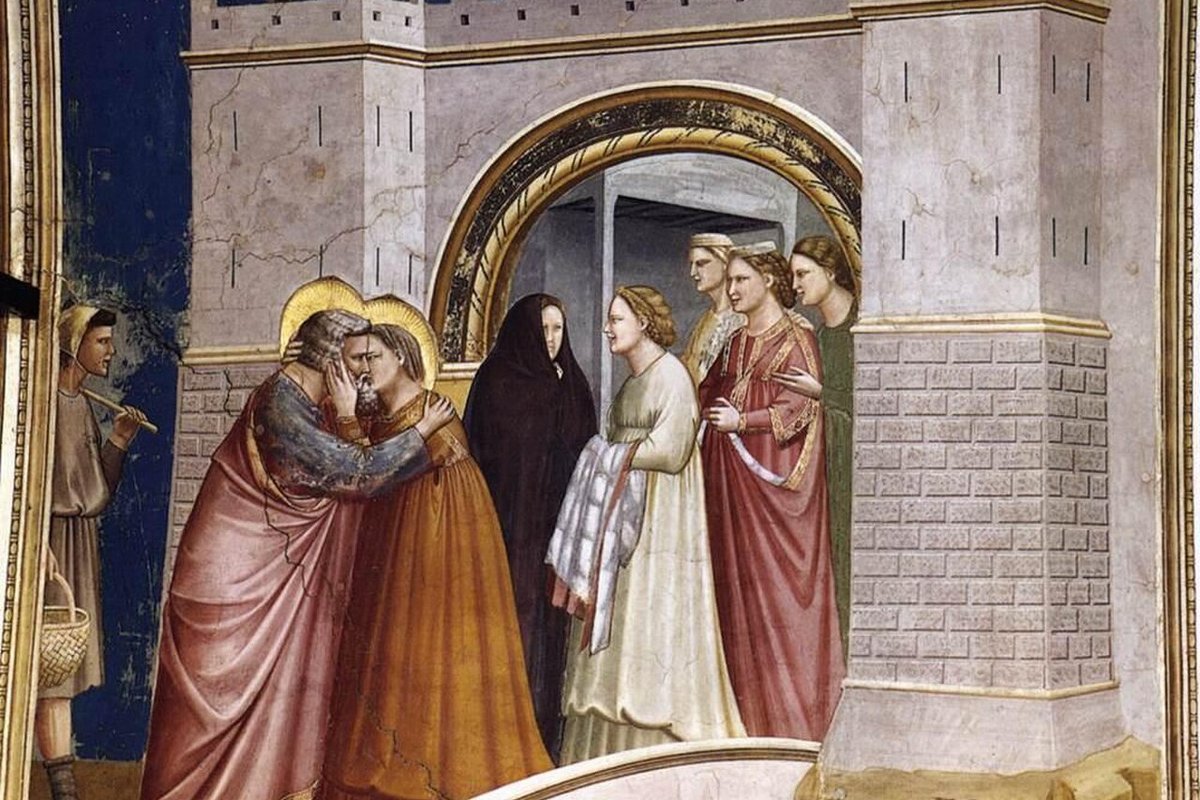
Giotto di Bondone, "Meeting at the Golden Gate," 1304-1306, Scrovegni Chapel, Padua — public domain.
The story tradition tells
According to the Protoevangelium, Joachim's childlessness becomes a public humiliation. The text describes him being turned away while attempting to present an offering at the Temple, told that a man with no children has no right to be first among Israel. Ashamed, Joachim withdraws into the wilderness, where he fasts and prays for forty days rather than return home. Anne, left behind and grieving in her own right, prays as well — and the two are answered, in the traditional account, by an angel who appears separately to each of them with the same message: they will conceive a child, a daughter who will be spoken of in every corner of the world. Joachim and Anne are reunited, according to the tradition, at Jerusalem's Golden Gate — a meeting later Christian art returned to again and again, most famously in Giotto's early 14th-century frescoes at the Scrovegni Chapel in Padua.
What's tradition, and what the Church actually affirms
It's worth being as clear about Joachim as about Anne: none of this narrative detail — his name, his wealth, the forty days in the wilderness, the angelic visitation — comes from Scripture. It is pious tradition, preserved and elaborated for centuries by a text the Church has never counted among the inspired books of the Bible. What the Catholic Church affirms with doctrinal weight is Mary's own identity and role as Mother of God; the specific identity and biography of her parents remain a matter of long-received tradition rather than defined dogma. The Church has nonetheless honored that tradition consistently and for a very long time — devotion to Joachim can be traced in the Eastern Church by around the 6th century, and his feast, along with Anne's, was extended to the universal Latin calendar centuries ago, today observed jointly on July 26.
An old pattern the story deliberately echoes
Readers familiar with the Old Testament will likely notice how closely Joachim and Anne's story follows a pattern that runs throughout Scripture: an older, childless, devout couple, humiliated by their inability to conceive, finally granted a child through direct divine intervention. Abraham and Sarah, promised Isaac in their old age (Genesis 18), and Zechariah and Elizabeth, told by the angel Gabriel that they would have a son named John despite Elizabeth's advanced years (Luke 1:5-25), follow the same basic shape. The author of the Protoevangelium of James was almost certainly writing with those biblical precedents deliberately in mind, framing Mary's birth as belonging to the same category of long-awaited, divinely granted children that populate salvation history from Genesis onward. That doesn't make the specific details about Joachim historically documented, but it does explain why the story felt immediately recognizable and credible to the early Christian communities who first received it.
It's also worth distinguishing this story clearly from a doctrine it's sometimes confused with. The angel's announcement to Joachim and Anne concerns their ability to conceive a child at all after years of childlessness — it has nothing to do with the Immaculate Conception, the defined Catholic dogma that Mary herself was conceived without original sin. The two ideas get blurred in casual conversation because both involve Mary's conception, but one is a piece of pious narrative tradition about an elderly couple's answered prayer, and the other is a formally defined article of Catholic faith concerning Mary's unique preservation from sin from the first moment of her existence.
A grandfather's place in a wider family story
Joachim's story also carries theological weight beyond simple sentiment. In later Catholic devotion, he and Anne became the anchor point for a broader meditation on the Holy Family across three generations — Joachim and Anne raising Mary, Mary raising Jesus, a chain of ordinary households through which extraordinary grace passed. Confraternities dedicated to Joachim and Anne spread across medieval Europe, and by the late Middle Ages their joint feast had become a genuinely popular observance, particularly among craft guilds who adopted the couple as patrons of family life and honest work. None of that popularity depended on historical documentation the way a modern biography would require — it depended on a story simple enough to be retold from parish to parish for a thousand years without losing its shape.
Why the tradition endures
Whatever its non-biblical origin, the story of Joachim answers a very human instinct: it gives Mary a family, a household, parents who longed for her before she was born. That instinct shows up constantly in Christian art and devotion — Joachim appears teaching a young Mary, embracing Anne at the Golden Gate, or standing quietly alongside her in family scenes that give the Holy Family a fuller, three-generation shape. Patron of fathers and grandfathers in Catholic devotion today, Joachim's appeal has never really rested on the historical precision of his story. It rests on the simplest of images: a man who wanted a child badly enough to fast in the wilderness for one, and who is remembered, alongside his wife, for the daughter that hope produced.
Trivia
Is Joachim mentioned anywhere in the Bible?
Where does Joachim's story actually come from?
What does the Protoevangelium of James say happened to Joachim?
What is Saint Joachim the patron saint of?
When is Saint Joachim's feast day?
You May Also Like
Related Reading