Saint Josephine Bakhita, Virgin

Stolen from her village
Josephine Bakhita's early life is reconstructed largely from her own later testimony, since she never knew her exact birth date and could not recall her original name. She was born around 1869 in the Darfur region of western Sudan, into a family she remembered as reasonably comfortable, with a father who was a village headman. That childhood ended abruptly when she was somewhere between seven and nine years old: slave traders seized her while she was outside the village, and she was marched, sold, and resold through a succession of owners over the following twelve years, moving through Sudanese and later Middle Eastern hands.
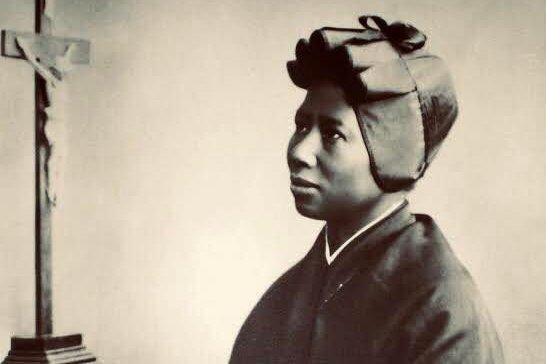
Photograph of Saint Josephine Bakhita, c. 1910, Canossian Sisters archive — public domain / CC0
The abuse she suffered during these years was severe even by the brutal standards of the nineteenth-century Sudanese slave trade. At one point her captors cut elaborate patterns into her skin — more than a hundred separate cuts across her chest, stomach, and arms, into which they rubbed salt to raise permanent scars, a practice intended as decorative branding of "ownership." Bakhita carried these scars visibly for the rest of her life and spoke about them only rarely, though she never hid them. It was during this period of captivity that she lost her own name; the psychological trauma of her abduction was severe enough that she genuinely could not recall it afterward, and "Bakhita" — the Arabic word for "fortunate," given to her mockingly or indifferently by one of her captors — became the only name she had.
From Khartoum to Venice
In the 1880s, Bakhita was purchased by Callisto Legnani, the Italian vice consul in Khartoum, whose treatment of her marked a real turning point — she later described this household as the first time in years she was not beaten. When Legnani returned to Italy, Bakhita went with him, and he subsequently placed her with the Michieli family, who employed her as a nanny for their young daughter, Mimmina. When business required the Michielis to travel to Sudan, they left both Bakhita and Mimmina in Venice under the care of the Canossian Sisters, an order of religious women dedicated to charitable and educational work — a decision that, without anyone fully intending it, would change the direction of Bakhita's entire life.
During her months with the Canossian Sisters, Bakhita encountered formal instruction in Christianity for the first time, though she later said she had already sensed, since childhood, the presence of what she called simply "the Master" — a benevolent power behind the sun, moon, and stars that she felt watching over her even during the worst of her enslavement, long before she had any Christian vocabulary to describe it. When the Michieli family returned to Italy and attempted to reclaim Bakhita to bring her back to Africa, she refused to go, and the resulting legal dispute reached an Italian court. In November 1889, the court ruled decisively: slavery had no legal standing under Italian law, and since Bakhita had technically been enslaved before ever setting foot in Italy, she had in fact been a free woman the entire time she lived there. The ruling freed her outright.
Becoming Sister Josephine
Bakhita was baptized on January 9, 1890, taking the name Josephine Margaret Fortunata — the last a Latin echo of the Arabic name she had carried since childhood. Three years later, in 1893, she entered the novitiate of the Canossian Daughters of Charity, and she made her final religious profession in 1896. For most of the remainder of her life she lived at the Canossian convent in Schio, a town in northern Italy, where she worked as a cook, seamstress, and doorkeeper, greeting visitors to the convent with a warmth and gentleness that made a deep impression on the local community.
The people of Schio came to know her affectionately as "Madre Moretta," the Black Mother, and generations of townspeople later recalled her not primarily as a survivor of extraordinary suffering but simply as a beloved, humble presence at the convent door — a woman known for her serenity, her ready smile, and a habit of referring to whatever happened to her, good or bad, with the phrase "as the Master wishes." She traveled occasionally in her later years to speak about her life and to support the Canossian order's missionary work, though she remained by all accounts reluctant to dwell publicly on the horrors of her enslavement, preferring to speak about the freedom and peace she had found afterward.
Canonization and a modern patronage
Josephine Bakhita died in Schio on February 8, 1947, and her death drew crowds of local mourners who had known her for decades. Pope John Paul II beatified her in 1992 and canonized her on October 1, 2000, making her the first person from Sudan to be recognized as a saint. Pope Benedict XVI later drew on her story at length in his 2007 encyclical Spe Salvi, presenting her as an example of hope discovered in the midst of profound suffering.
In the years since her canonization, Bakhita's story has taken on a particular modern significance: because her own life was defined by kidnapping, forced servitude, and eventual legal emancipation, the Church has embraced her as its principal patron saint for victims of human trafficking and modern slavery, a form of exploitation that persists worldwide despite the legal abolition of slavery in nearly every country. Her feast day, February 8, is also observed by the Church as an international day of prayer and awareness against human trafficking, connecting a nineteenth-century Sudanese girl's suffering directly to a crisis still facing millions of people today.
Trivia
Where was Saint Josephine Bakhita born, and what happened to her as a child?
Why is she called Bakhita instead of her birth name?
How did Bakhita gain her freedom?
What did Bakhita do after gaining her freedom?
What is Saint Josephine Bakhita the patron saint of?
You May Also Like
Related Reading