Saint Mark the Evangelist

A young man in Jerusalem
The New Testament gives only scattered glimpses of the man behind the second Gospel, but they add up to a recognizable figure. The Acts of the Apostles describes a John Mark whose mother, Mary, hosted a house church in Jerusalem — described as a gathering place significant enough that when Peter was miraculously freed from prison, it was to this house he went first (Acts 12:12). That detail suggests the family was established and respected within the earliest Jerusalem Christian community, likely from its very first years.
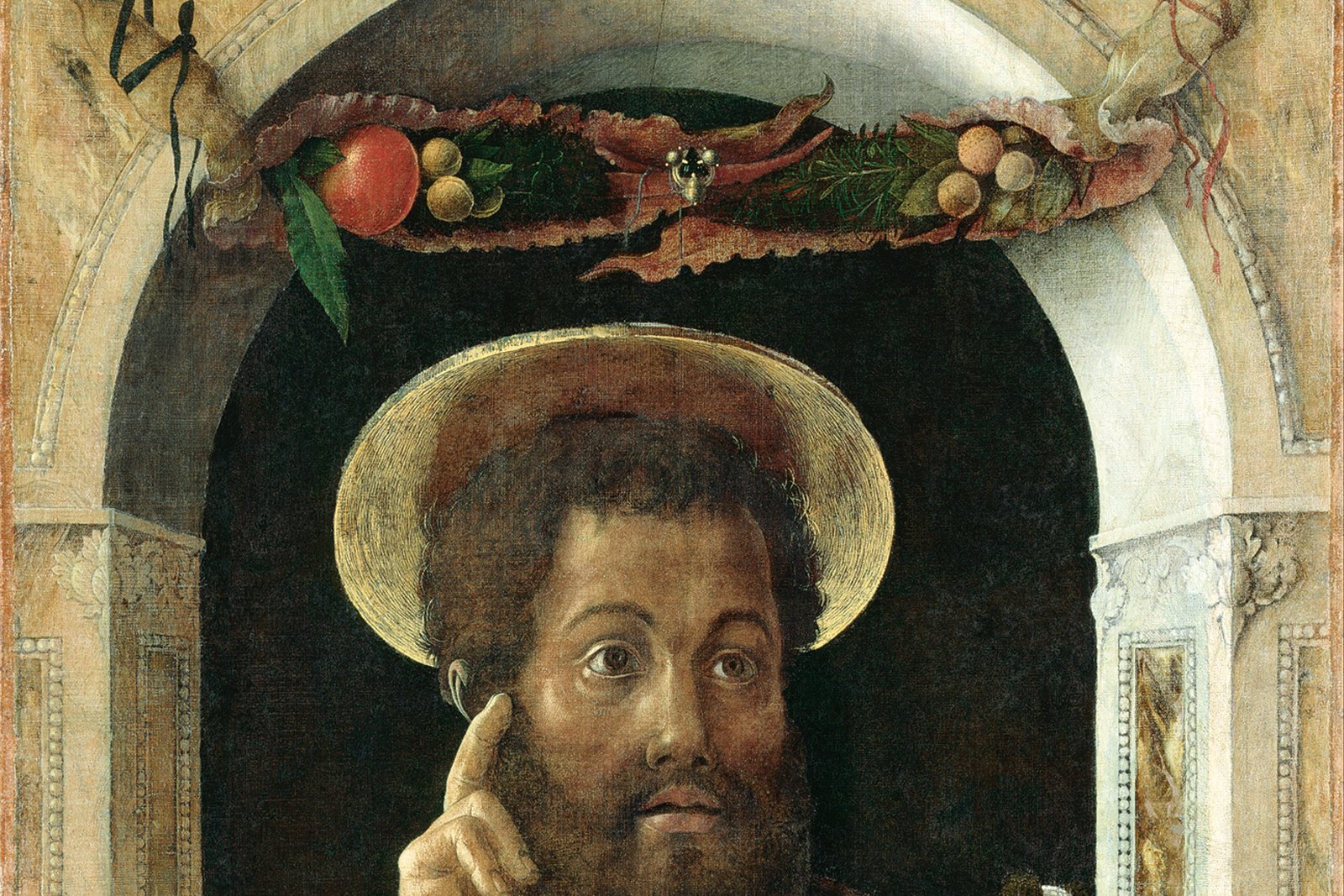
Andrea Mantegna, Saint Mark the Evangelist, c. 1450, Städel Museum, Frankfurt — public domain
Mark later accompanied his relative Barnabas and the apostle Paul on part of their first missionary journey, but left partway through, a decision that led to sharp disagreement between Paul and Barnabas before their next planned journey (Acts 15:37-39) — one of the few candidly human conflicts recorded among the early Church's leaders. Later New Testament letters suggest the rift healed; Paul refers to Mark warmly and asks for him by name in a letter written near the end of his own life (2 Timothy 4:11), describing him as "very useful" for ministry.
The disciple who wrote what Peter preached
The strongest and earliest tradition about Mark's Gospel comes not from the New Testament directly but from a bishop named Papias, writing in the early second century and quoted by the historian Eusebius: that Mark, "the interpreter of Peter," wrote down accurately, though not in order, what he remembered of Peter's own preaching about the words and deeds of Christ. This tradition explains several features that have long struck readers of Mark's Gospel — the vivid, eyewitness-feeling detail in individual scenes, alongside a narrative structure that jumps quickly between episodes rather than building a smoothly ordered account, consistent with a text assembled from someone else's spoken preaching rather than composed from the start as a single continuous history.
Peter himself, in his first letter, refers to "my son Mark" (1 Peter 5:13), a phrase generally read as evidence of a close, almost familial working relationship between the two men during Peter's later ministry, likely in Rome — the same city early tradition consistently places Mark in when he composed his Gospel, probably sometime before or shortly after Peter's death there in the persecution under Nero.
The Gospel that runs
Whatever the exact circumstances of its composition, the Gospel of Mark reads unlike any of the other three. It is the shortest of the four canonical Gospels, and most modern scholars consider it the earliest written, likely used as a source by both Matthew and Luke when they composed their own accounts. Its hallmark is speed: the Greek word usually translated "immediately" appears dozens of times, driving the narrative forward from one episode to the next with almost no pause for the long teaching discourses that fill so much of Matthew and John.
That urgency shapes the portrait of Jesus that emerges from Mark's pages — a Christ constantly in motion, healing, casting out demons, and provoking growing opposition, moving toward the cross with a momentum the reader feels even on a first read. Mark's Gospel also famously ends, in its earliest and most reliable manuscripts, on an abrupt note at the empty tomb (Mark 16:8), a conclusion that unsettled early copyists enough that longer endings were added in some later manuscript traditions — a textual history scholars still study closely today.
A naked flight from Gethsemane
One of the Gospel's strangest details appears during the account of Jesus's arrest in Gethsemane: "Now a young man followed him wearing nothing but a linen cloth about his body. They seized him, but he left the cloth behind and ran off naked." (Mark 14:51-52, RSV-CE). The moment is unexplained, mentioned nowhere else in the Gospel, and attached to no named character — an oddity many scholars over the centuries have read as the author's own discreet signature, a private detail included by someone who was there but chose not to name himself directly, much as ancient authors sometimes wove themselves anonymously into their own narratives. The Church has never made this identification a matter of settled teaching; it remains an interpretive tradition rather than a doctrinal claim, but it has shaped how many readers picture Mark himself.
Alexandria, the lion, and a body stolen twice
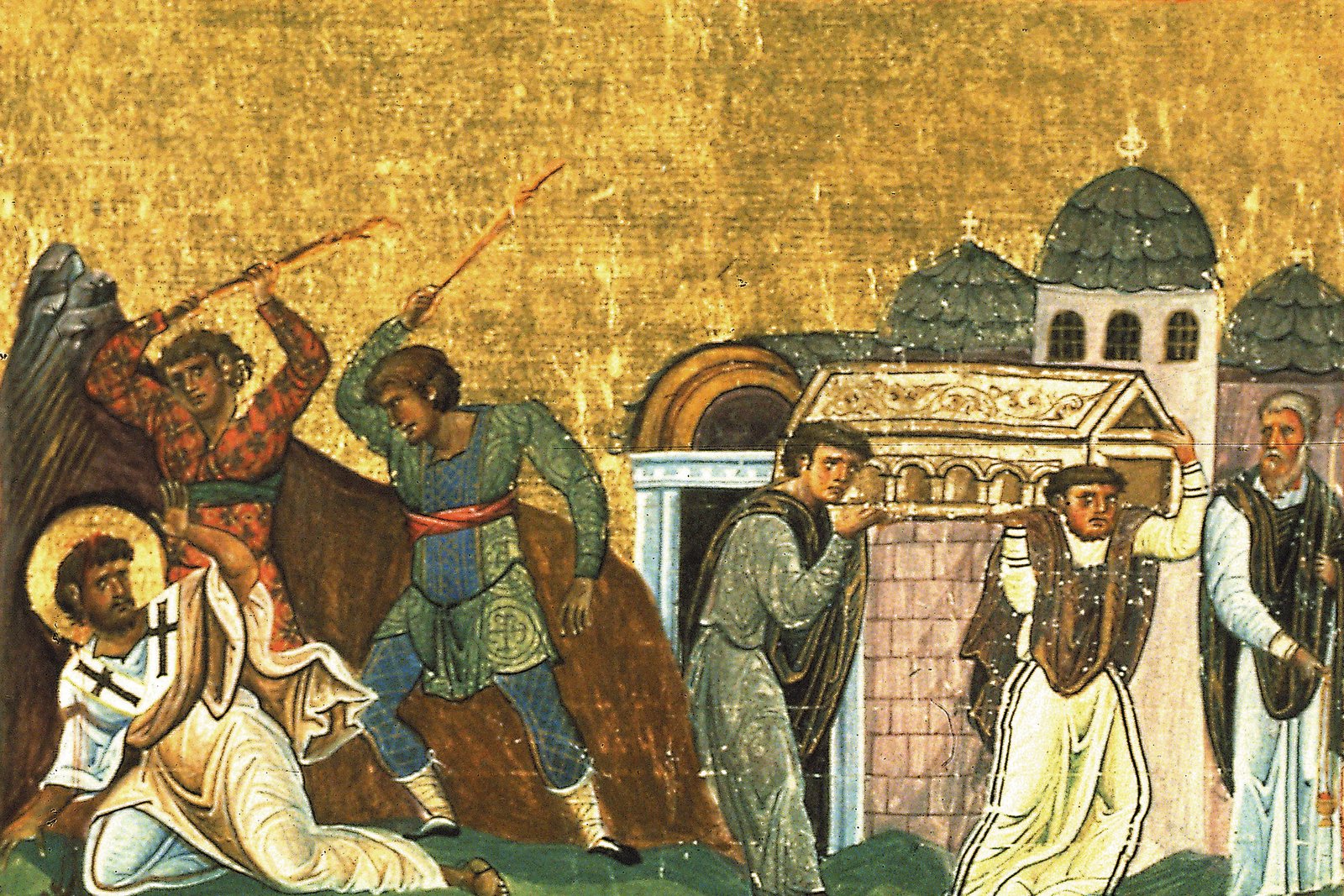
Church tradition, recorded by the historian Eusebius, holds that Mark went on to found the Christian church in Alexandria, Egypt, becoming its first bishop and suffering martyrdom there, reportedly dragged through the city's streets by a mob hostile to the new faith. Alexandria's Christian community continued to claim him as its founding figure for centuries afterward, and the Coptic Orthodox Church still traces its own apostolic lineage directly back to him today.
Mark is traditionally symbolized by a winged lion — one of the four living creatures of Ezekiel's vision and the Book of Revelation (Revelation 4:7), assigned to each Gospel writer since at least Saint Jerome's day and generally connected to Mark's Gospel opening abruptly with "a voice of one crying out in the desert" (Mark 1:3, NABRE), evoking the roar of a lion in open, empty country. That same lion became the symbol of an entire city: in 828, Venetian merchants smuggled Mark's relics out of Muslim-controlled Alexandria, reportedly hiding them beneath a cargo of pork to deter Muslim customs inspectors from searching too closely, and brought them to Venice, where the Basilica di San Marco was built to house them and the winged lion became the enduring emblem of the city itself — a saint's memory reshaped into the coat of arms of a maritime republic many centuries after his death, much as Saint Peter's memory anchors Rome.
Trivia
Was Mark the Evangelist an apostle or an eyewitness to Jesus's ministry?
Is Mark the same person as John Mark mentioned in the Acts of the Apostles?
Why is Mark's Gospel considered distinctive among the four Gospels?
What is Saint Mark's symbol, and why is it a lion?
What is Saint Mark's feast day?
You May Also Like
Related Reading