Saint Paul Miki and Companions — The Martyrs of Nagasaki

A mission under growing suspicion
Christianity arrived in Japan in 1549 with the Jesuit missionary Francis Xavier, and for several decades afterward it spread with surprising speed, aided by regional lords who saw political and trade advantages in welcoming Portuguese and Spanish missionaries. By the 1590s, hundreds of thousands of Japanese Christians had been baptized, churches had been built in major cities, and a new generation of native Japanese clergy and religious, including Paul Miki, had been trained within the mission itself.
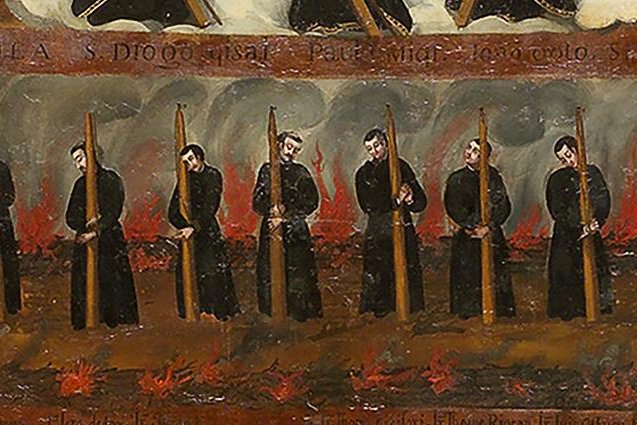
Anonymous Japanese master, Martyrdom of Paul Miki and Companions in Nagasaki, c. 1635 — public domain
That growth alarmed Toyotomi Hideyoshi, the powerful military ruler who had unified much of Japan under his control. Hideyoshi had initially tolerated the missionaries, but he grew increasingly wary of what he saw as a foreign religious and political network operating inside his territory, one with loyalties that ran to Rome and to European powers rather than to him. Tensions escalated further after a diplomatic incident involving a shipwrecked Spanish vessel, whose crew reportedly boasted — whether accurately or not — that missionaries were sent ahead of conquest, feeding Hideyoshi's suspicion that Christian missions were a prelude to colonization. In late 1596, he ordered the arrest of Franciscan missionaries and their converts in Kyoto and Osaka as a public example.
Paul Miki, a son of privilege who chose the mission
Paul Miki was born around 1562 into a prominent Japanese military family — his father was a respected commander — and received an education far removed from the poverty that marked many early Japanese converts. Rather than pursuing the career his background would have opened to him, Miki entered the Society of Jesus as a young man and trained as a seminarian, becoming known across the Jesuit mission in Japan as an unusually gifted preacher. Japanese sources describe him as eloquent and persuasive in a way that made him particularly effective at winning converts among the educated classes, a skill that made him valuable to the mission and, ultimately, a target when the crackdown came.
When Hideyoshi's order for arrests went out, Miki was seized in Kyoto along with a group that eventually numbered twenty-six: six Franciscan friars, most of them European missionaries; three Japanese Jesuits, including Miki; and seventeen Japanese laypeople who had been closely associated with the Franciscan mission — catechists, an interpreter, and ordinary lay Christians, among them two boys, Louis Ibaraki and Anthony of Nagasaki, aged just twelve and thirteen.
A month-long march to Nagasaki
The prisoners were not executed immediately. Instead, as part of the punishment's deterrent design, they were mutilated — a portion of each captive's left ear was cut off — and paraded publicly through several cities before being marched nearly 600 miles overland, in the depth of winter, to Nagasaki, the city with the largest concentration of Christians in Japan and therefore the location where the execution would carry the greatest symbolic weight. Contemporary accounts describe the group singing hymns and reciting prayers along the route, and several more Japanese Christians reportedly joined the condemned voluntarily along the way, wanting to share their fate, though the number ultimately executed remained twenty-six.
They arrived in Nagasaki in early February 1597 and were crucified on a hill overlooking the harbor on February 5, each tied and then bound to an individual cross planted in the ground, with soldiers standing by to pierce each victim with a lance once the crosses were raised — the method of execution reserved in Japan at the time for the most serious crimes.
The sermon from the cross
What has made this martyrdom especially remembered within the Church is the account of Paul Miki's final minutes, preserved by witnesses and passed down as part of the official record supporting his later canonization. Bound to his cross and facing the crowd gathered to watch, Miki is recorded as having preached rather than pleaded — declaring that he forgave Hideyoshi and everyone responsible for his death, that he held no hatred toward his executioners, and that he hoped his death might draw others in the crowd toward the same faith he was dying for. It is an echo, deliberate or not, of Christ's own words from the cross, and it is precisely that echo that made the account so powerful within the early Church's understanding of what had happened in Nagasaki — not a defeat of the mission, but its most vivid proof.
The youngest victims reportedly showed a similar composure: witnesses recorded that the boy Louis Ibaraki, asked by an onlooker if he wished to recant to save his life, refused and asked instead to be shown which cross was his.
Protomartyrs of Japan
The twenty-six martyrs of Nagasaki were beatified by Pope Gregory XV in 1627 and canonized together by Pope Pius IX in 1862, honored collectively as the protomartyrs of Japan — the first martyrs of that mission field formally recognized by the Church, though far from the last, since persecution of Japanese Christians continued intermittently for decades afterward, eventually driving the faith underground for over two centuries. Their feast is celebrated on February 6. The site of their execution in Nagasaki is marked today by a monument and museum, and the survival of an underground Christian community in the region through centuries of prohibition — rediscovered by missionaries only in the nineteenth century — is often traced back, in Catholic memory, to the witness given on that hill. Readers interested in other missionary martyrdoms from the same era of global evangelization may also want to read about Saint Francis Xavier, the Jesuit missionary whose work first brought Christianity to Japan half a century before Miki's death.
Trivia
Who was Saint Paul Miki?
Why were the martyrs of Nagasaki executed?
How many martyrs were killed alongside Paul Miki?
What did Saint Paul Miki say before he died?
When were the martyrs of Nagasaki canonized?
You May Also Like

Related Reading