Saint Paul VI, Pope

From a Brescia household to the Roman Curia
Giovanni Battista Montini was born in 1897 near Brescia, in northern Italy, to a family deeply engaged in Catholic public life — his father was a lawyer, journalist, and member of the Italian parliament active in the Catholic political movement of the era. Ordained a priest in 1920, Montini spent most of his working life not in a parish but inside the Vatican's own diplomatic and administrative machinery, joining the Vatican Secretariat of State in 1922 and rising over the following decades to become one of its most senior and trusted officials, working closely under Pope Pius XII through the traumatic years of the Second World War, including efforts to assist refugees and prisoners displaced by the conflict.
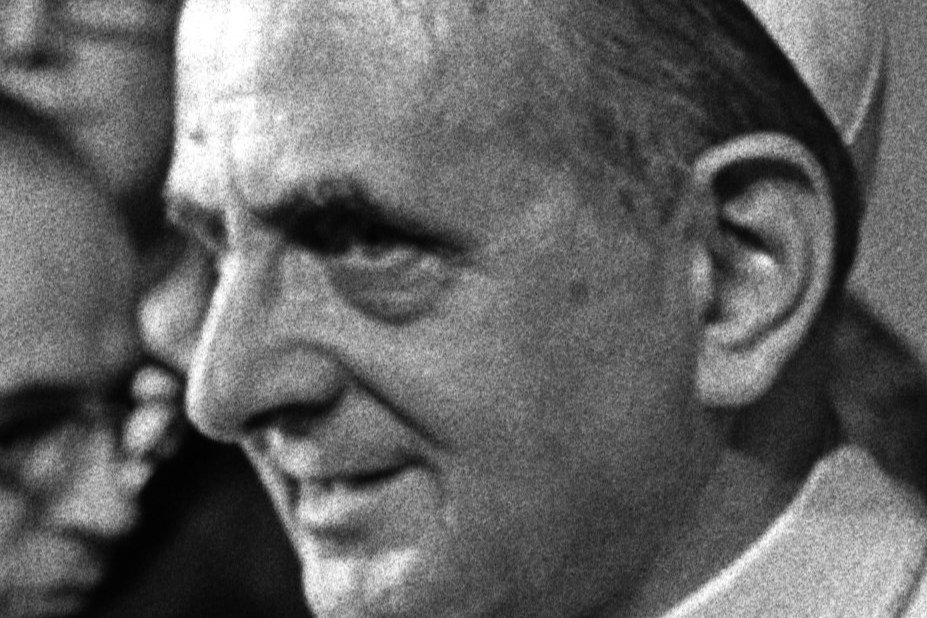
Yoichi Okamoto, official White House photograph of Pope Paul VI, 23 December 1967, U.S. National Archives — public domain (U.S. government work)
In 1954 Pius XII named him Archbishop of Milan, one of the largest and most significant dioceses in Italy, where Montini earned a reputation as a pastorally engaged, socially attentive bishop who visited factories and worked to address the growing distance between the industrial working class and the Church. Pope John XXIII made him a cardinal in 1958, and when John XXIII died in 1963 — midway through the historic Second Vatican Council he had convened the previous year — the College of Cardinals elected Montini to succeed him. He took the name Paul VI.
Finishing a council he did not begin
Paul VI's entire pontificate was shaped by the fact that he inherited, rather than initiated, the Second Vatican Council — an event that had already set in motion the most sweeping reexamination of Catholic life and practice in centuries. Rather than dissolve or dramatically redirect it, Paul VI chose to see it through, presiding over its final three sessions between 1963 and 1965 and personally promulgating its sixteen closing documents, including Lumen Gentium on the nature of the Church and Gaudium et Spes on the Church's relationship to the modern world.
He then spent the following decade overseeing the difficult, often contentious work of implementing those documents in practice: reforming the liturgy to permit Mass in local languages rather than exclusively in Latin, reorganizing the Roman Curia, and establishing new structures such as the Synod of Bishops to give bishops from around the world a regular, ongoing voice in Church governance alongside the pope. These changes were welcomed by many Catholics as overdue and were resisted by others as a rupture with tradition — a tension that Paul VI, by temperament a careful, deliberative reformer rather than a revolutionary, felt keenly and wrote about with evident personal strain in his own private reflections during these years.
A pope who left Rome
For over a century before Paul VI, popes had rarely if ever traveled far from Rome, largely a legacy of the Church's fraught nineteenth-century relationship with the newly unified Italian state. Paul VI broke decisively with that pattern, becoming the first pope in the modern era to travel by airplane and visit multiple continents during his pontificate — journeys that earned him the informal title "the Pilgrim Pope." He traveled to the Holy Land in 1964, where he met Ecumenical Patriarch Athenagoras I of Constantinople in a historic gesture of reconciliation between the Catholic and Orthodox Churches after nine centuries of separation since the Great Schism of 1054; to India; to the United Nations headquarters in New York, where he delivered a famous address pleading "no more war, war never again"; and eventually to several other countries across Asia, Oceania, and Africa. These journeys, unremarkable for a head of state today, were genuinely novel for a papacy that had for generations been defined by its physical confinement to the Vatican.
Humanae Vitae and a difficult reception
No document from Paul VI's pontificate has been more discussed, or more contested, than his 1968 encyclical Humanae Vitae ("Of Human Life"). The letter addressed questions of married love and the regulation of births, and after convening a commission of theologians and laypeople to study the question — a commission whose majority report reportedly leaned toward permitting some forms of artificial contraception — Paul VI ultimately reaffirmed the Church's traditional teaching against it, while also offering an extended, positive reflection on the nature and dignity of married love that is often read separately from the encyclical's more debated conclusions. The document's reception was sharply divided: some bishops' conferences and theologians publicly dissented, while the pope's supporters argued that later social developments vindicated concerns he had raised in the letter about the wider consequences of separating sexuality from procreation. The controversy weighed heavily on Paul VI personally, and he wrote no further encyclicals during the remaining decade of his pontificate.
Canonization and lasting memory
Paul VI died on August 6, 1978, at the papal summer residence of Castel Gandolfo — fittingly, on the feast of the Transfiguration, a feast whose themes of change and revealed glory many commentators later noted as strikingly apt for a pope whose defining task had been guiding the Church through change. Pope Francis beatified him in 2014 and canonized him on October 14, 2018, in a ceremony that also canonized Archbishop Óscar Romero of El Salvador. In his canonization homily, Francis praised Paul VI as a pope who, in the midst of a difficult and often turbulent period, remained "a witness of the primacy of Christ" and of the Church's mission of service.
Paul VI's pontificate connects naturally to that of his more widely known successor, Saint John Paul II, who as a young bishop personally participated in the Second Vatican Council under Paul VI's guidance and spent much of his own later pontificate carrying forward the same conciliar reforms Paul VI had first implemented. Today Paul VI is remembered less for any single dramatic act than for the patient, often thankless work of steering an institution as vast as the Catholic Church through one of the most consequential periods of change in its long history — a legacy the Church continues to weigh, debate, and draw on more than four decades after his death.
Trivia
What is Saint Paul VI known for?
Is Saint Paul VI the same person as Pope John Paul II?
Why was Humanae Vitae controversial?
When was Paul VI canonized?
What is the feast day of Saint Paul VI?
You May Also Like
Related Reading