Saint Bernardine of Siena, Priest

Who was Saint Bernardine of Siena?
Bernardine was born in 1380 in Massa Marittima, a small hill town in Tuscany, to a family of minor nobility connected to the great city of Siena. Orphaned by the age of seven, he was raised by an aunt who instilled in him a deep devotion to the Blessed Virgin Mary, a devotion he carried for the rest of his life. As a young man in Siena he joined a confraternity dedicated to caring for the sick, and in 1400, when plague swept through the city, the twenty-year-old Bernardine took charge of the city's main hospital, nursing the dying for months at a time. The exhausting work left him seriously ill himself, and by the time he recovered, he had decided to abandon the world entirely.
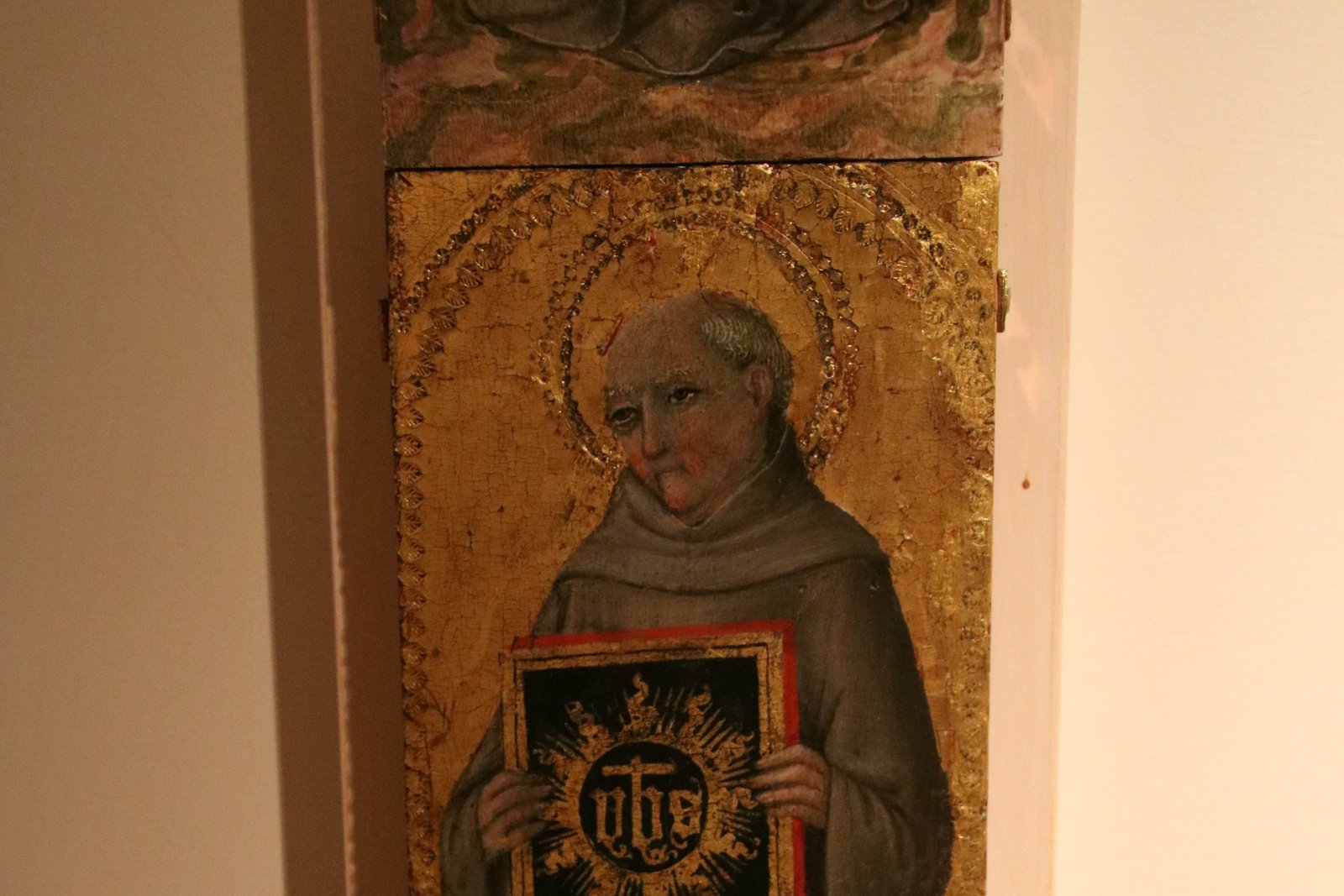
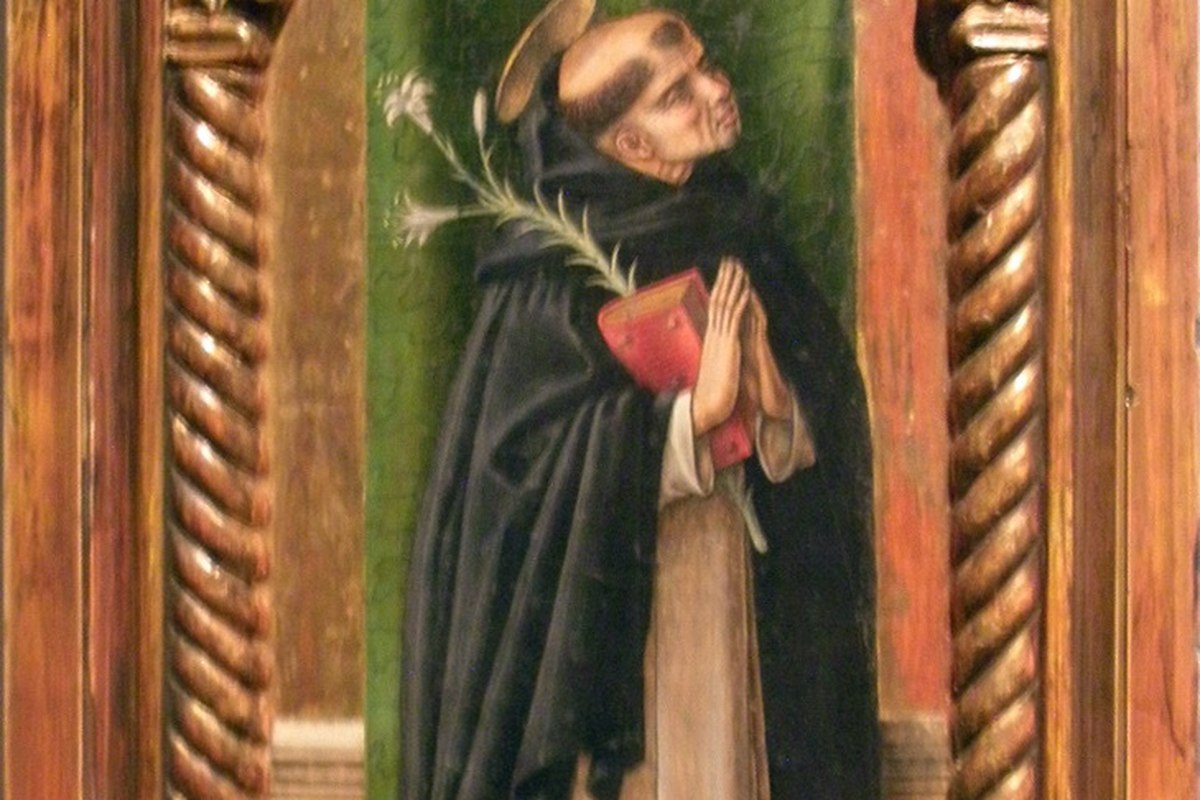
Sano di Pietro, Saint Bernardino, circa 1450-1470 — public domain.
At twenty-two he entered the Franciscan Order, choosing the stricter, more austere branch of the friars known as the Observants, who sought to return to the simplicity of life that Saint Francis of Assisi had originally laid out two centuries earlier. He was ordained a priest in 1404, but for over a decade afterward he lived quietly, largely out of the public eye, troubled by a weak and hoarse speaking voice that seemed to disqualify him from the preaching ministry he felt called toward. Tradition holds that he spent years in prayer and private practice before that voice strengthened into the powerful instrument that would eventually draw crowds of many thousands across Italy.
The preacher who reshaped a violent century
Fifteenth-century Italy was a patchwork of rival city-states, and Bernardine's own lifetime coincided with some of the bitterest civic and family feuds the peninsula had seen — vendettas, gambling addiction, usury, and factional violence that could tear a town apart for generations. Beginning around 1417, Bernardine set out on a preaching campaign that would eventually take him through most of central and northern Italy, delivering sermons that sometimes lasted three or four hours and drew crowds so large that towns had to open their main piazzas because no church could hold them.
He preached in the everyday Italian of the streets rather than formal Latin, used vivid stories and concrete examples that ordinary people could follow, and did not shy away from calling out specific social sins by name — usury, gambling, sodomy, and the long-running vendettas between families and cities. Accounts from witnesses describe entire towns responding to his sermons by publicly burning gambling equipment, cosmetics associated with vanity, and other symbols of the behavior he preached against, in bonfires that came to be called "bonfires of vanities" — a phrase later echoed, less piously, by Girolamo Savonarola in Florence decades afterward.
The Holy Name and the wooden tablet
Bernardine's most lasting contribution to Christian devotion was his promotion of the Holy Name of Jesus. He carried into his sermons a wooden tablet on which he had painted the letters IHS — a Christogram formed from the first three letters of "Jesus" in Greek (ΙΗΣΟΥΣ) — surrounded by golden rays representing the sun. At the climax of his preaching he would hold the tablet aloft and invite the crowd to venerate the Holy Name together, a practice meant to redirect the fierce loyalties that fueled Italy's family and civic feuds toward a single, shared devotion that could unite rather than divide a city.
The symbol proved enormously popular and spread quickly across churches, civic buildings, and private homes throughout Italy — it can still be seen carved above doorways and painted on facades in Tuscan and Umbrian towns today. But its popularity also drew scrutiny. Some theologians and rival preachers accused Bernardine of promoting a kind of idolatry, arguing that venerating a written symbol too closely resembled superstition. He was summoned to Rome and formally examined before Pope Martin V around 1427, and the case was investigated again a few years later under Pope Eugene IV. Both times he was cleared of any doctrinal error, and papal approval helped the devotion spread even further rather than suppressing it. The Catechism of the Catholic Church today affirms that "the invocation of the holy name of Jesus is the simplest way of praying always" (CCC 2668), a modern echo of exactly the devotion Bernardine spent his life promoting.
Reformer of his own order
Beyond his public preaching, Bernardine devoted enormous energy to reforming the Franciscan Order from within. He served three terms as vicar general of the Observant Franciscans, the reform-minded branch dedicated to a stricter observance of Saint Francis's original rule of poverty and simplicity, which by the fifteenth century had grown lax in many communities. Under his leadership the Observant movement grew from a small handful of houses to hundreds of friaries across Italy, and his organizational and administrative skill — a less visible legacy than his preaching, but arguably just as important — helped ensure the movement's survival and expansion long after his death. He also refused three separate offers to be made a bishop, preferring to remain a simple friar free to continue his itinerant preaching, a choice that itself became part of his reputation for humility.
Death, canonization, and lasting memory
Bernardine died on May 20, 1444, in the town of Aquila (modern L'Aquila) in central Italy, while traveling on yet another preaching journey despite failing health. He was canonized remarkably quickly — just six years later, in 1450, by Pope Nicholas V, a reflection of how widely and immediately he was venerated across Italy even in his own lifetime.
Because of his reputation as perhaps the most persuasive and technically accomplished public speaker of his era, the Church later named him patron of advertisers and communications professionals, an unusual but fitting honor for a man whose entire mission depended on the power of the spoken word to change hearts. His devotion to the Holy Name also connects naturally to the broader Franciscan tradition carried forward by later saints such as Saint Francis of Assisi himself, and to other reforming preachers of the late medieval Church, including Saint John of Kanty, whose own austere, teaching-focused life unfolded in Poland during roughly the same century. The IHS monogram Bernardine made famous remains one of the most widely recognized symbols in Catholic art today, appearing on everything from vestments to architecture, a quiet but enduring trace of a friar who believed that a single name, rightly honored, could heal a fractured city.
Trivia
What is Saint Bernardine of Siena known for?
What does the IHS symbol on Saint Bernardine's tablet mean?
Why was Saint Bernardine investigated by the Church?
What is Saint Bernardine of Siena the patron saint of?
When is the feast day of Saint Bernardine of Siena?
You May Also Like
Related Reading