Saints Zelie and Louis Martin

Two people who first tried, and failed, to enter religious life
Both Zelie Guerin and Louis Martin arrived at marriage only after first believing their calling lay elsewhere. Louis Martin, born in 1823 in Bordeaux and raised largely in Alencon, tried as a young man to join the Augustinian Canons of the Great St. Bernard Hospice, a religious community in the Alps famous for its work rescuing travelers in the mountains. He was turned away because he lacked sufficient Latin for the community's requirements. Zelie Guerin, born in 1831 also near Alencon, likewise sought a religious vocation, applying to the Sisters of Charity of Saint Vincent de Paul, and was told directly that she did not have a calling to that particular community's life.
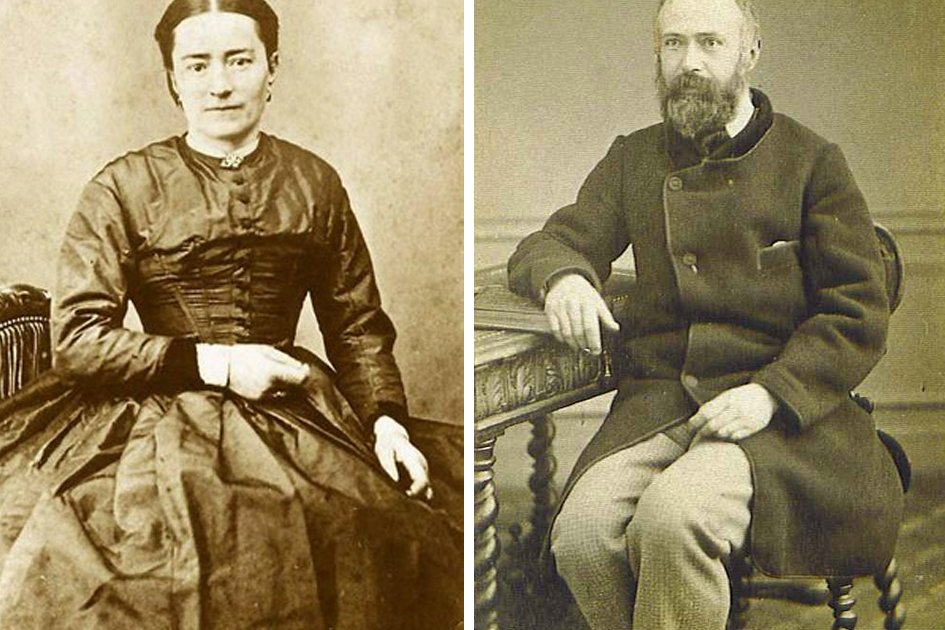
Unidentified 19th-century photographer, portraits of Louis and Zelie Martin — public domain.
Both eventually accepted, in different ways and at different times, that their path to holiness would run through ordinary lay life rather than the convent or monastery walls — a conclusion that would later become central to how the Church presented their canonization: not as a story of two people who "settled" for marriage, but as a recognition that family life itself can be a genuine and complete path to sanctity.
A quick courtship and a demanding household
Zelie and Louis met in Alencon in 1858 and married just three months later, on July 13 of that year, in a ceremony held at midnight — a detail their daughter Therese would later recount in her own writing about her parents. Louis worked as a watchmaker and jeweler, a respectable trade, but it was Zelie's own business — a Point d'Alencon lace-making workshop she ran from their home, employing several other lacemakers — that became the family's principal source of income. She managed the business's finances, correspondence, and production with evident skill, work she carried out alongside raising an eventually large family, a combination of demands that her surviving letters describe in exhausting, candid detail.
The couple had nine children between 1860 and 1873. Four of them — two sons and two daughters — died in infancy or early childhood, losses that Zelie's letters record with unvarnished grief rather than any easy pious resignation, even as she continued to frame her children's deaths within her Catholic understanding of the afterlife. The five daughters who survived to adulthood all entered religious life as nuns, an unusually complete outcome for one family, and the youngest of them, Therese, born in 1873, became one of the most significant Catholic spiritual writers of the modern era.
Zelie's death and Louis's later years
Zelie was diagnosed with breast cancer in the early 1870s and died on August 28, 1877, when Therese, her youngest daughter, was only four years old. Her death left Louis to raise five daughters, ranging in age from young children to young women, largely on his own, and the family relocated from Alencon to Lisieux to be closer to Zelie's brother and his family, who helped support the household in the years that followed.
Louis lived to see four of his daughters enter Carmel — including Therese, whose entry into the convent at just fifteen he personally supported and helped arrange, an unusually young age that required special ecclesiastical permission. In his final years Louis suffered a series of strokes and significant mental decline, a difficult and humbling period for a man who had spent his life as the steady head of his household; he died on July 29, 1894.
How the Church came to canonize them as a couple
Therese of Lisieux herself was canonized in 1925, and her own writings — above all her spiritual autobiography, Story of a Soul — repeatedly credit her parents' faith and example as foundational to her own vocation. Interest in Zelie and Louis's own sanctity grew steadily over the following decades, driven in large part by the continuing popularity of their daughter's cause, but their canonization process treated them as figures worth recognizing in their own right, for their conduct of an ordinary married and family life under real hardship, rather than simply as supporting characters in Therese's story.
Pope Francis beatified them together in 2008 and canonized them together on October 18, 2015, during a Synod of Bishops on the family — a deliberate pairing of occasion and honorees, presenting Zelie and Louis explicitly as models of holiness lived out within marriage and parenthood rather than despite it. They were the first married couple in the Catholic Church's history to be canonized jointly specifically for their life together as spouses and parents.
Feast day
Their joint feast is kept on July 12, close to the anniversary of their July 13, 1858 wedding.
Related reading
Readers interested in the Martin family's spiritual legacy will find the fullest expression of it in their daughter's own story — see Saint Therese of Lisieux — and in the broader tradition of family holiness within French Catholicism reflected in Saint Elizabeth of the Trinity, another French Carmelite of the same era shaped by a devout family upbringing.
Trivia
Who were Saints Zelie and Louis Martin?
How many children did Zelie and Louis Martin have?
Did Louis or Zelie Martin want to enter religious life themselves before marrying?
What did Zelie and Louis Martin do for a living?
When is the feast day of Saints Zelie and Louis Martin?
You May Also Like

Related Reading