Medieval Missionary Bishops of the Carolingian and Ottonian Empire

An empire built on bishoprics
Charlemagne didn't just conquer territory — he covered it in dioceses. Every region he brought under Frankish rule got a bishop, a cathedral school, and a mandate to bring the local population, often only nominally Christian or not Christian at all, into full religious conformity with the rest of the empire. His grandsons and great-grandsons kept the pattern going, and when the Carolingian line finally gave out in East Francia, the Ottonian kings who replaced it in 919 leaned on the same tool even harder: a bishop loyal to the throne, holding both spiritual authority and very real political power over a stretch of land, was one of the few figures a 10th-century king could actually trust to hold a frontier together.
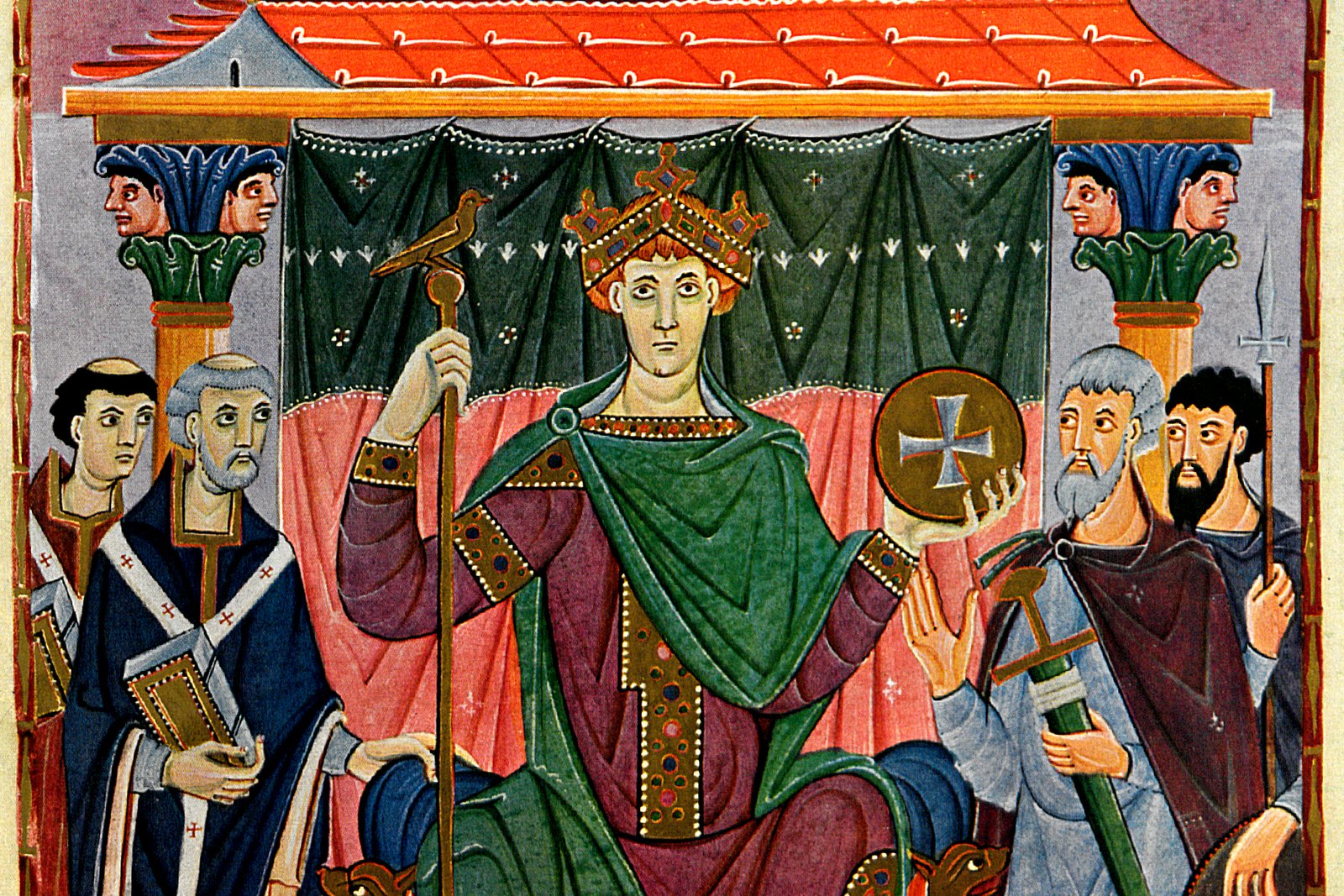
Master of the Reichenau School, Otto III Enthroned, from the Gospels of Otto III, c. 1000, Bayerische Staatsbibliothek, Munich — public domain.
That's the backdrop for the extraordinary concentration of bishop-saints this period produced. Some were reforming administrators tightening up an already-Christian Francia. Others were sent out past the empire's living edge — into Saxony, Frisia, and the Slavic lands beyond the Elbe — where "diocese" sometimes meant a handful of huts and a population that had never heard a Christian sermon. A striking number of the men below did not die peacefully in bed.
Bishops of the Rhineland and Francia
The Rhine corridor was the administrative and spiritual spine of the Carolingian world, and its bishoprics produced some of the era's most consequential reformers.
- Saint Anno of Cologne — the powerful 11th-century archbishop of Cologne who effectively ran the regency government for the young King Henry IV, a churchman as comfortable in palace politics as in the cathedral.
- Saint Lambert of Maastricht — a bishop murdered around 705 after confronting a nobleman over a moral scandal, whose cult later gave rise to the city of Liège, built around his shrine.
- Saint Nicetius of Trier — a 6th-century bishop of Trier remembered for standing up to Merovingian kings on questions of justice, an early model for the churchman-as-royal-conscience role later Carolingian bishops inherited.
- Saint Germanus of Paris — a 6th-century bishop of Paris whose abbey, later renamed Saint-Germain-des-Prés in his honor, became one of Francia's most important religious foundations.
- Saint Caesarius of Arles — a Gallic bishop whose monastic rule and reforming councils shaped church discipline across southern Francia well before Charlemagne's time, laying groundwork the Carolingian reformers built on directly.
- Theodulf of Orléans — a Visigothic-born bishop and poet at Charlemagne's own court, one of the architects of the Carolingian Renaissance's revival of learning, and a key figure in the era's push for a literate, disciplined clergy. Read more at /blog/en/saints/theodulf-of-orleans/.
- Saint Norbert of Xanten — a wealthy courtier turned uncompromising reforming archbishop of Magdeburg who founded the Premonstratensian order, bridging the Ottonian reform tradition into the 12th century.
Missionaries to the Slavic and Frisian frontier
East of the Elbe and along the North Sea coast, the "bishop" title often meant something closer to "missionary with a see he had barely visited."
- Saint Adalbert of Magdeburg — the first archbishop of Magdeburg, dispatched on an earlier mission to the Rus' that collapsed under hostility before he returned to lead the new archdiocese built specifically to anchor Christianity east of the Elbe.
- Saint Bruno of Querfurt — a missionary bishop killed by pagan Prussians in 1009 while preaching on the Baltic frontier, one of the clearest examples of how dangerous this work actually was.
- Saint Ludger of Münster — the first bishop of Münster, who spent years evangelizing Frisia and Saxony before founding the diocese that anchored Christianity in the Frankish-Saxon borderlands.
- Saint Meinwerk of Paderborn — an Ottonian-era bishop of Paderborn known for an ambitious building program of churches and monasteries that helped cement Christian institutional life in Saxony.
- Saint Virgil of Salzburg — an Irish-born bishop of Salzburg who organized missionary efforts into Carinthia and the Alpine Slavic lands to the empire's southeast.
- Saint Wolfgang of Regensburg — a 10th-century bishop of Regensburg who briefly left his diocese to evangelize among the Magyars before returning to reform Bavarian monastic life.
Scholar-monks, hermits, and local patrons
Not every notable churchman of the era held a bishop's crozier — some shaped the church from a monastery cell or a hermitage instead, and others became the enduring face of a single city.
- Saint Notker the Stammerer — a monk of the Abbey of St. Gall renowned as a composer, poet, and chronicler of Charlemagne, one of the Carolingian Renaissance's most distinctive literary voices.
- Saint Pirmin of Reichenau — the founding abbot of Reichenau Abbey on Lake Constance, whose scriptorium later produced some of the finest illuminated manuscripts of the Ottonian era.
- Saint Meinrad of Einsiedeln — a Benedictine hermit murdered by robbers around 861, whose hermitage grew into the great Abbey of Einsiedeln in Switzerland.
- Saint Fridolin of Säckingen — an early missionary monk credited with founding the abbey at Säckingen on the upper Rhine, a figure of genuinely obscure historical record but enduring local devotion.
- Saint Emmeram of Regensburg — a 7th-century missionary bishop martyred in Bavaria, whose relics made Regensburg's abbey of St. Emmeram one of the region's most important pilgrimage sites.
- Saint Conrad of Constance — a 10th-century bishop of Constance remembered for his personal austerity and for completing the cathedral his predecessors had begun.
- Saint Hermann Joseph of Steinfeld — a Premonstratensian mystic of Cologne, a later figure whose devotional life carried the Rhineland's contemplative tradition into the high Middle Ages.
Why they still matter
None of these men are household names the way Charlemagne or Otto the Great still are, but they're arguably why the empire those kings built held together at all. A crowned king could win a battle; it was the bishop who stayed behind afterward, built the church, trained the next generation of local clergy, and made sure the conquest actually stuck. Read together, their stories trace the literal edges of Latin Christendom as it existed a thousand years ago — from the Rhine cathedrals at the empire's secure center out to the Baltic coast, where the frontier was still being fought over one diocese at a time.
Trivia
Why did the Carolingian and Ottonian period produce so many bishop-saints?
What's the difference between a Carolingian and an Ottonian saint on this list?
Were these bishops sent to convert pagans, or to reform an already-Christian clergy?
Did any of these bishops die violently on the mission field?
Why do so many of these saints have almost no popular devotion today outside their home dioceses?
You May Also Like
Related Reading